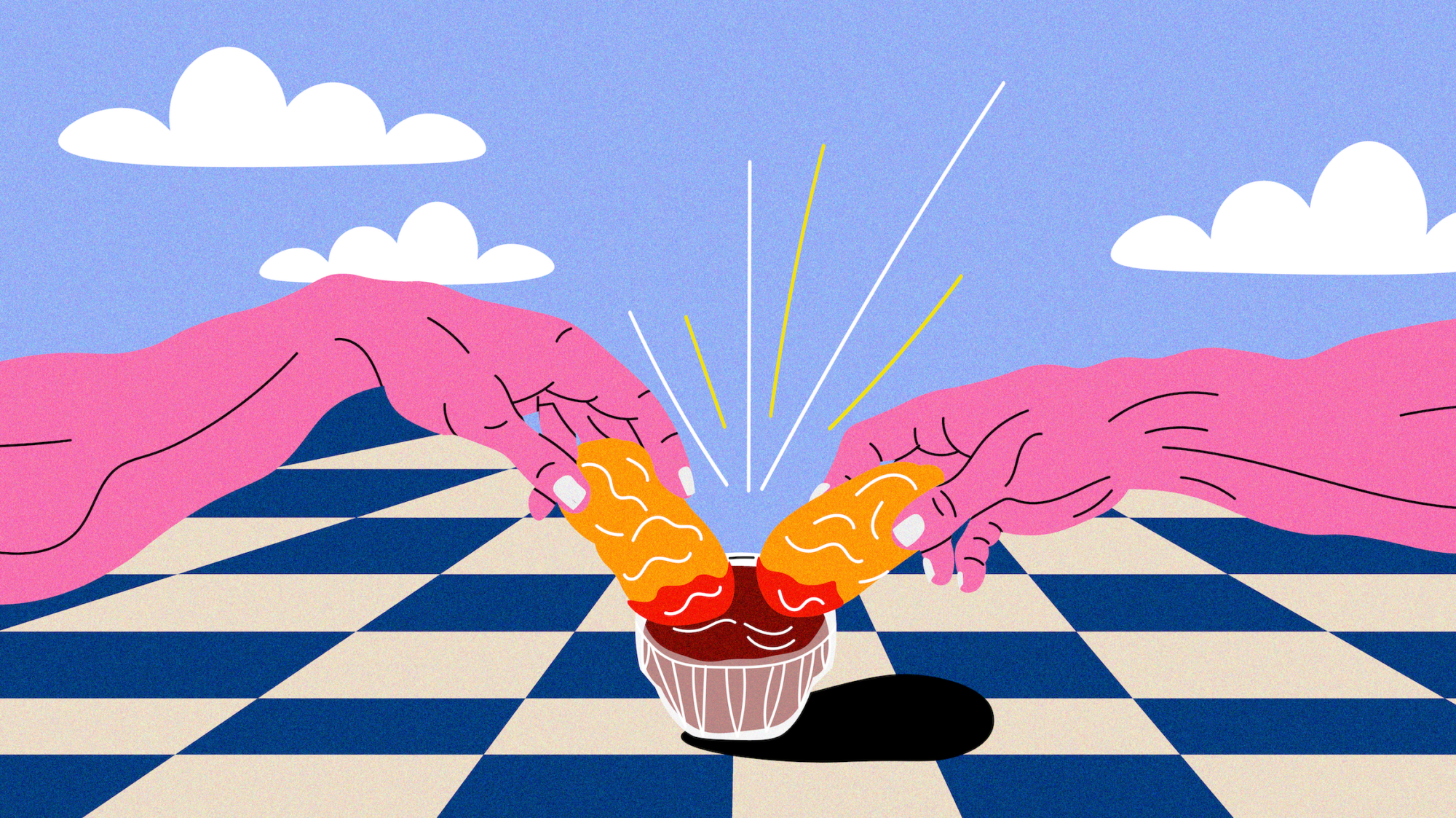
Across grocery freezer aisles and farmers’ markets alike, the breaded vessels for nostalgia are being reimagined as health foods, wholesome snacks, and convenient fast-food substitutes
Farmers’ markets are a haven for whole, unprocessed foods. For many, it’s a place where one can go to escape the parade of chemical additives and fillers lurking in every supermarket aisle—like a trip to an unspoiled nature reserve. So you can imagine my surprise when, during a recent tour of my local Greenmarket in Manhattan, while gathering bumpy carrots and three-ingredient yogurt, I passed a pastured meat purveyor with an unusual item on its burlap-clad counter: a bag of frozen chicken nuggets.
Sure, one could argue that the bratwurst and saucisson that this farm—the Woodbury, Connecticut–based Ox Hollow Farm—was also selling are similarly processed foods. But the term “nuggets” just hits a little differently. When you’re eating nuggets, you’re no longer at a long barn table strewn with cut radishes and cultured butter. You’re in a plastic booth at a kids’ arcade, with ketchup at the ready. You’re picking up fast food from a drive-through window. Or you’re a busy mom, scuttling sheet pans of dinosaur-shaped poultry from the freezer into the oven.
At least, those were the ways I’d experienced chicken nuggets growing up. Many weeknight dinners consisted of the baked, breaded nugs served alongside tater tots. I didn’t care for burgers early on, so nuggets were my go-to order from fast-food chains during road trips (dipped in ketchup, rather than the syrupy-tasting barbecue sauce). Any which way, I loved them.
A few weeks later, after tasting Ox Hollow Farm’s juicy yet reassuringly nostalgic-tasting nuggets and trying many more brands’ offerings from the frozen aisles of supermarkets, I spoke with Stephanie Maynard, co-owner of the family-owned farm, on the phone.
Having been raised on fast food, Maynard vowed to do things differently with her children and established Ox Hollow Farm with her husband, Mark, in 1997. They raise cows, pigs, and chickens for meat, selling locally and online. The nuggets, available to ship nationwide, are a newer addition as of last year—the farm had been working with a processor to produce ground chicken to make use of excess breast and drumstick meat, and they were looking for a value-added product to make from it. The resulting nuggets’ ingredient list reads a bit more like a cookbook recipe than most frozen-food labels: chicken, oats, sea salt, fennel, cayenne, apple cider vinegar, and celery powder used as a natural binder. The breading comes from Mennonite bakers who use whole-grain flours instead of bleached white flour. By comparison, the average list of ingredients from a bag of mass-produced chicken nuggets from the supermarket is much longer, with obscure additives like “food starch” and “natural flavor.”
“We’re offering parallel foods to fast food, but I think it resonates with the idea that this is quick and easy, and we all need something that simplifies our life,” says Maynard. I ask whether adults, the ones without children, purchase the nuggets at their farmstands. Some are hesitant, she admits. They might say they’ll have to wait until their niece is in town to try it. “We’re constantly looking for an excuse to eat a fun and easy food, but we’re busier than kids,” she says. “I say to adults all the time, ‘It’s okay, adults eat these more than children.’”
Ostensibly for children but beloved by all ages, chicken nuggets are an all-American junk food that has, in recent years, become a bit less junky and a little more grown-up. Across grocery store freezer aisles and farmers’ market coolers alike, brands are reinventing nuggets as vehicles for nutritional fads and culinary creativity, all while preserving the nostalgia and convenience that made them beloved in the first place. They’re pumping up the protein macros, frying them in beef tallow, and stuffing them with cheesy jalapeños; today’s nuggets may be gluten-free, grain-free, seed-oil-free, and, yes, still shaped like dinosaurs. They’re increasingly marketed not just to children but to busy adults, athletes, college students, and health-conscious families. And behind many of them lies a broader shift in how Americans think about comfort food: people still want foods that feel familiar and indulgent, but they also want convenience and nutrition.
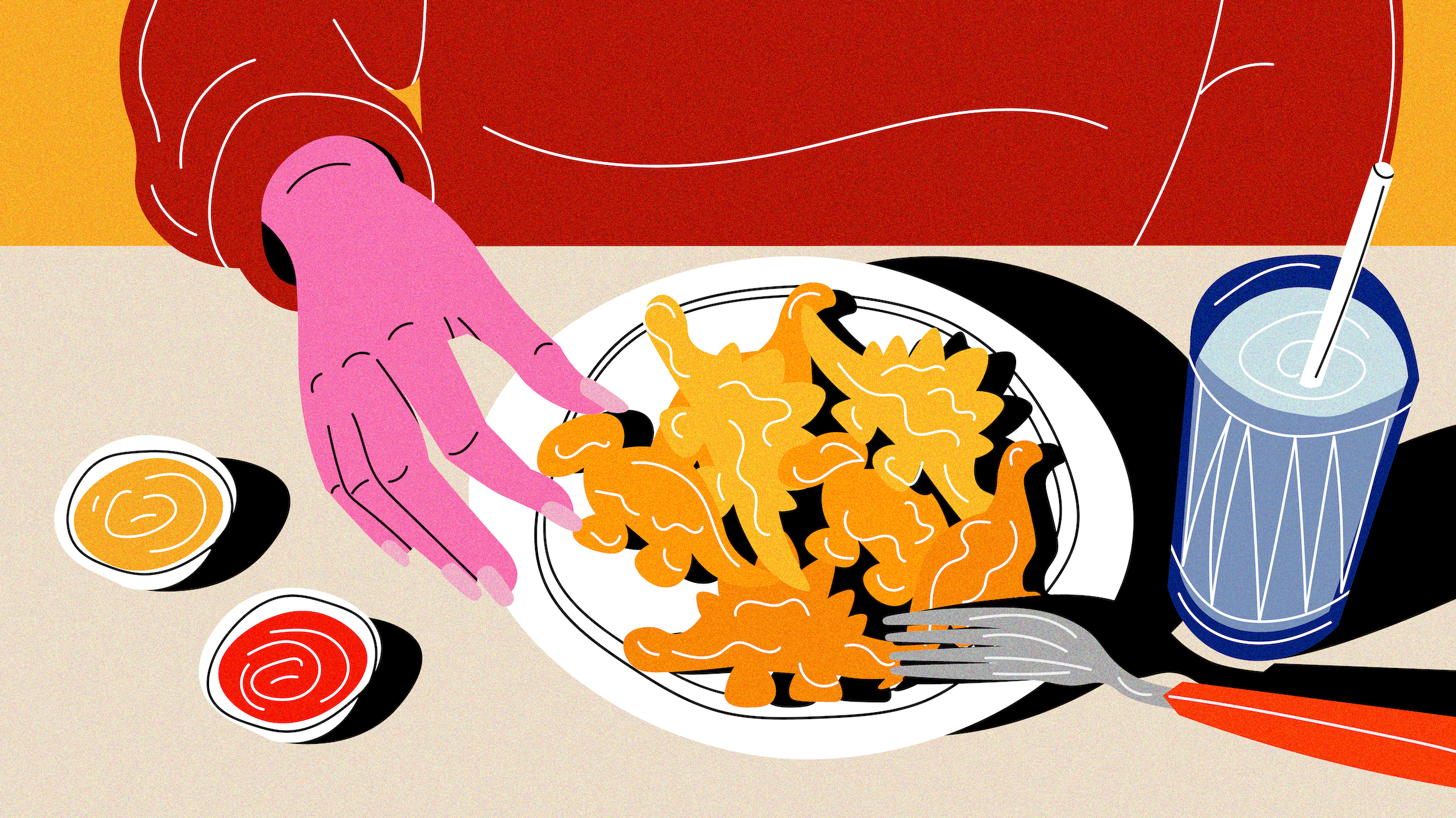
To be sure, chicken nuggets stand apart from breaded chicken tenders, strips, or chunks of whole pieces of chicken muscle, because the chicken underneath that breading has been ground, pulverized, or processed somehow. While these may all seem like similar offerings, you can’t form alphabet or animal shapes out of the others—a feature that has helped place nuggets firmly in the domain of kids’ food.
“The reality is that all adults love them,” said Christina Zwicky, chief marketing officer of the Chicago-based Real Good Foods. “People want better-for-you versions of food that they already love.”
Founded in 2017 as a better-for-you frozen foods brand, Real Good Foods began selling frozen breaded chicken chunks and strips in 2022, which quickly became their top sellers and flagship products. Multiple breaded chicken SKUs have followed since, including popcorn chicken, dino-shaped chicken nuggets, and varieties with no seed oil or gluten. Prominently displayed on each package is the protein content per serving, a number from 20 to 23 grams.
“We’ve figured out how to deliver a delicious breading that increased the protein without giving up on the textural experience,” says Zwicky. The secret ingredients to achieve that include whey protein and chickpea flour. That’s why, she says, these products are increasingly appealing to busy but health-minded adults rather than just children. In the ’80s and ’90s, a lot of convenience foods that strove to be healthy really sacrificed on taste, Zwicky recalls—think fat-free cookies with sugar substitutes. Real Good Foods is trying to do the opposite of that with its frozen chicken products.
Zwicky calls them her “kitchen ninja” for her family of four, which includes two teenage boys. They’ll make a salad or stir-fry with the strips or chunks; they’ll serve the nuggets with ketchup and ranch. Whatever the case, they can go from freezer to plate in about 15 minutes, and she feels good about the protein and nutrition they’re all getting. “It makes household meal planning really simple: We just keep our freezer stocked with every shape and size,” says Zwicky.
They’re pumping up the protein macros, frying them in beef tallow, and stuffing them with cheesy jalapeños; today’s nuggets may be gluten-free, grain-free, seed-oil-free, and, yes, still shaped like dinosaurs.
Even legacy brands of frozen foods are finding new audiences for their nuggets. Pilgrim’s, an 80-year-old brand that began as a small feed store in Texas in 1946 and grew into a nationally distributed frozen foods brand, relaunched in 2024 with retooled recipes and a refreshed brand voice promising to make chicken “stupid fun again.” Now its selection of air-fryer-tailored frozen chicken nuggets includes flavors like buttery popcorn and dill pickle, and even “loaded” chicken nuggets, oozing with the likes of cheesy jalapeño and chicken pot pie filling.
“Quick-service restaurants have been pushing bold chicken experiences for years, but the grocery aisle hadn’t kept up,” says Chelsea Parker, the senior director of marketing for Pilgrim’s. Chicken nuggets had been a big driver of growth for the brand in years prior, even despite a stagnation in innovation, says Parker—with the only new products being different-size packages rather than exciting new flavors. That led the brand to go whole hog (or whole hen?) on chicken nugget innovation, creating a crispier breading and flavors that can satisfy without sauce.
Now more than half of Pilgrim’s customers of frozen chicken products are adults without children, according to Parker. “Kids still love them, but these are designed for anyone who wants craveable, easy-to-enjoy chicken,” she says.
Chicken patties, chicken sausages, chicken meatballs, chicken cold cuts—these, along with chicken nuggets, might be traced back to a common ancestor: the chicken stick, invented by Cornell University professor Robert C. Baker in 1963. He’d been tasked with trying to revitalize a slumping poultry industry in upstate New York, and he came up with a number of value-added products (as well as one regionally famous chicken barbecue sauce recipe). At the time, chicken wasn’t the ubiquitous protein in the United States that it is today; in fact, it lagged behind beef and pork in availability until the 1990s, according to the US Department of Agriculture. One could say that Baker’s inventions succeeded in helping push chicken to the forefront of the American diet, and our appetites for it only continue to grow. The USDA estimates that Americans will eat 42.2 billion pounds of chicken in 2026.
Chicken nuggets have been evolving outside the supermarket aisles, too. Across the country, fine-dining restaurants are making house-made nuggets and topping them with caviar, like the specialty served at the US Open in 2024 by the New York–based Korean fried chicken restaurant Coqodaq. (Even McDonald’s got in on the McNugget Caviar action.) Influencers are creating their own homemade nugget recipes, some with a healthy-ish angle, like mixing in “hidden veggies.” Fast-food giants that previously stayed far from the genre, like Taco Bell, are launching their own nuggets. Even cross-branded nuggets shaped like, say, the Philadelphia Eagles’ mascot as a Super Bowl tie-in, are a thing now.
But the frozen, ready-to-reheat variety of chicken nugget has become a popular item in my home, ever since my toddler started eating solid foods—and then became disinterested in most of them. Prior to my discovery of the Ox Hollow Farm nuggets at the farmers’ market, I might still have turned my nose up at the entire category. But watching my son happily “boop” a breaded morsel into mayo and ketchup, then take several bites of it of his own volition (a rare victory), any hesitations I might have had about nuggets faded immediately. Now I peck, boop, and munch on nuggets often myself, keeping them stocked in the freezer along with dumplings. The circle of life has brought me back to some of my earliest comfort foods—and, well, less cooking.