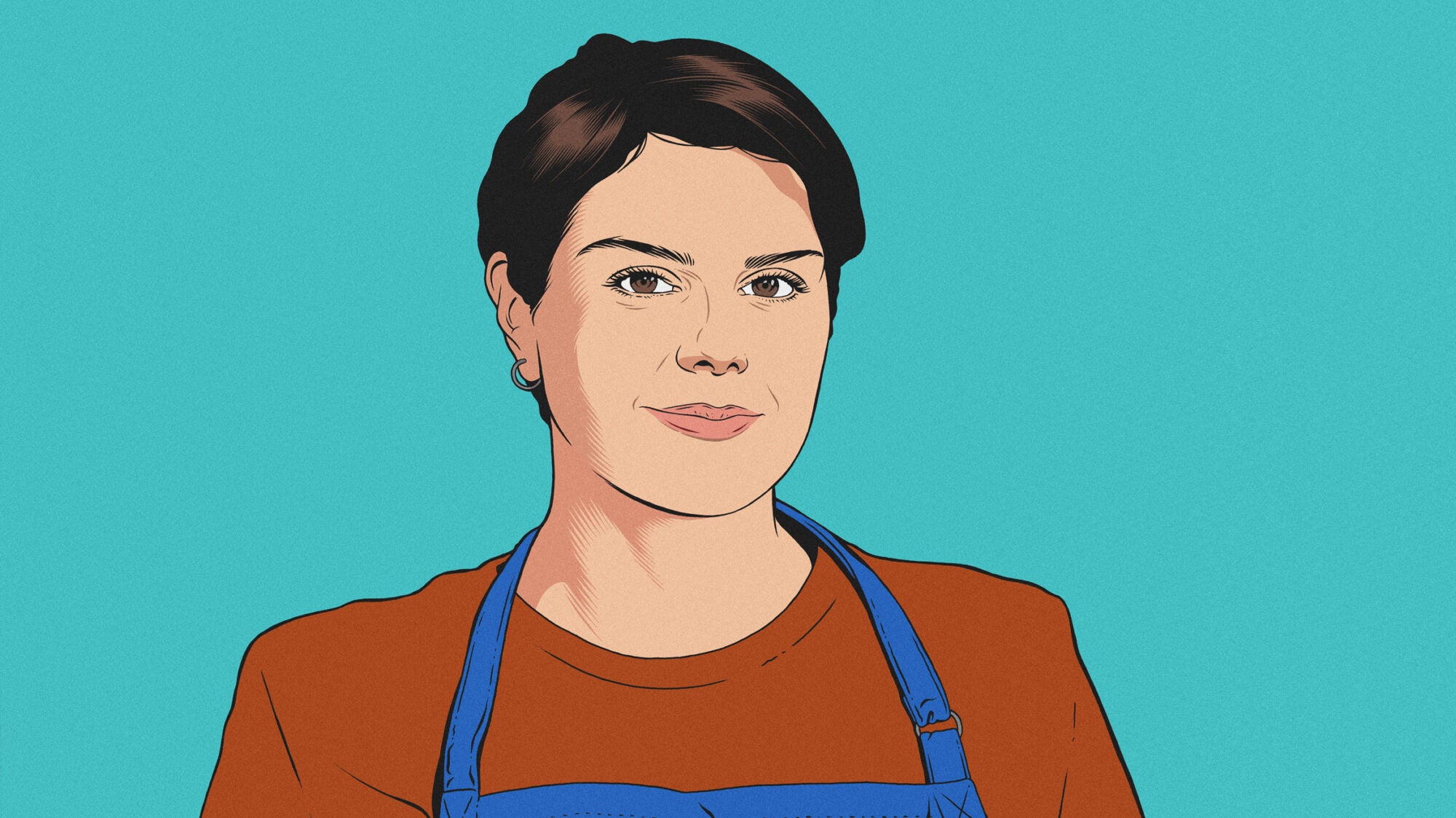
Rosio Sanchéz grew up on Chicago’s South Side, the daughter of Mexican immigrants, and went on to become head pastry chef at Noma before making one of the more unexpected moves in modern food: opening a taquería in Copenhagen. Today she runs Hija de Sanchez and restaurant Sanchez, where she’s spent more than a decade making the case for Mexican food in Scandinavia—using heirloom corn, indigenous ingredients, and a fine-dining sensibility that’s entirely her own. We talk about her highly personal work and what it means to cook Mexican food so far from home.
Also on the show, we sit down with Dhriti Arora, the Indian-born Noma-alum chef behind Bar Vitrine, one of the most exciting openings in Copenhagen in recent years. The intimate 16-seat wine bar and eatery is where Dhriti brings her Indian roots into conversation with local, seasonal produce—cooking that feels like it couldn’t exist anywhere else in the world.
Check out our recent episode, TASTE Travels: Copenhagen
Read the full transcript:
Matt Rodbard Rosio Sánchez, welcome. This Is Taste. How are you?
Rosio Sánchez I’m good. Thank you for having me.
Matt Rodbard Well, you know what? Thank you for having me. We’re in Copenhagen, in your restaurant, Sanchez. I love when we can take the show on the road. We rarely do it, but we’re going to be doing a little bit more.
Rosio Sánchez Six inches of snow on the ground. Twelve inches. I mean, I’m used to it from Chicago, but this is crazy.
Matt Rodbard It’s crazy. I’m getting a little nostalgic though — we walked over here because we couldn’t get a cab. The Danes weren’t quite prepared for the storm.
Rosio Sánchez I wasn’t prepared. We were like, we don’t even have a shovel.
Matt Rodbard Literally, before you got here, we were shoveling with a sheet tray.
Rosio Sánchez Oh my gosh. That’s amazing. That’s so crazy. I love it. So creative.
Matt Rodbard We appreciate you shoveling for us. It’s really long time coming to come on the show. I just want this conversation to be about your work here in Copenhagen, at your restaurants — Hija de Sanchez and then, of course, Sanchez. We’re sitting in your tasting menu restaurant, which has been open since 2017. We’re gonna talk all about it. We’ll get to WD days and really all about the Wiley connection to Noma. It’s kind of nutty. Before we get to that — when you’re not in your own restaurant, where in Copenhagen do you like to dine out?
Rosio Sánchez Recently it’s been — I really like barbecue. And more often than not, I’m eating at home, because my husband cooks a lot of like, Taiwanese dishes, which is very different for me. But I would say a favorite of mine is actually Acme. Those are my two right now.
Matt Rodbard Who’s the chef there?
Rosio Sánchez Emil. This is a small group of three people. Like Japanese, French style, amazing counter service. A small restaurant, high quality ingredients, but it feels so casual — it’s really fun.
Matt Rodbard We went to Vitrine last night. Had a wonderful meal there. And, you know, I haven’t been here in a decade, but I’ve been to Copenhagen many times. We’re post-Noma in many ways. Noma is in LA right now, and you’re here, and Copenhagen has moved on. But places like Vitrine — this scene here, the flavors are jumping out of these restaurants in a way that perhaps during the Noma days, ten years ago, wasn’t happening. Describe that.
Rosio Sánchez I mean, ten years ago, you said to yourself — you were here, and it was almost desolate. Could you find a good restaurant that you wanted to eat at on a Sunday? Yeah, it was a very different time, and now there are so many more options. Manfred was one of the first ones I remember. It was so exciting, so different — casual, high quality, delicious bread, nice wines, affordable. You could see everyone there — the whole industry was eating at the same time. Now it’s so different. The city has expanded a bit to Nordhavn and Carlsberg. New neighborhoods being developed, so there are more options for restaurants because there’s more territory. It’s exciting.
Matt Rodbard For our listeners — maybe a decade ago, you’d go to Copenhagen in beautiful summer weather, go to Noma, maybe Geranium, a few other places. You didn’t have many options in different formats. But now, of course, you have Hija de Sanchez helping bring Mexican street food to Copenhagen. Very, very cool moment. I feel like we need to talk about bringing the taco to Denmark. You did that.
Rosio Sánchez I mean, I grew up in Chicago. My parents are from Mexico. For anyone that knows Chicago, there’s a really great neighborhood called La Villita that has a lot of great Mexican food. There’s also Pilsen and other places. I grew up with really good Mexican food. Every time I had any time off from Noma, I’m like, I need to go home, and I need a torta. I need a taco. I would get so excited. And it kind of felt like — God, if people can know what it is to have a good taco.
I remember making them in my small apartment, kind of trying to figure all these things out, and realizing that, after quite a few years in the industry, I hadn’t even tapped into my Mexican heritage. There are so many things. I was making mole at home. I was trying to make a nixtamal tortilla at home. And I thought — this can be something that I can dedicate myself to and learn more about where I come from.
Matt Rodbard Yesterday we had a beautiful potato taco. We had broccoli. And the tortillas are outstanding. Just getting the corn here and getting these products to Denmark — not easy.
Rosio Sánchez Especially the early days. It had to be fresh corn tortillas, because when you have a nice taco, it’s basically coming from a really well-made tortilla. And obviously the meat needs to be seasoned well. So being in Copenhagen, corn was number one. Another part was also chiles, spices, cheese — if I could narrow down Mexican food, it’s corn, chiles, spices, cheese, chocolate. So it was very easy to see: let’s for sure get the corn from Mexico.
I actually tried cooking with different corn from Holland and nearby countries, but it just wasn’t the same. So we did order from Mexico and tried different varieties. It was very expensive. But since day one, we’ve been importing corn to make the nixtamal. That’s been ten years now — very hard and very expensive in the first few years, but it eased up once we had four places. Then we could breathe. Because the complexity of the whole operation is that when you launch, it’s expensive and price sensitive, so you’re doing this impossible thing of importing corn at the most expensive price, but trying to draw customers in.
Matt Rodbard It was such a romantic idea.
Rosio Sánchez I didn’t really think about it so much. Now that I think about it, I’m like, what was the plan? But it worked out. The tacos would be great, and we just went for it. If all else fails, it was really delicious and we made something fun.
Matt Rodbard Well, let’s go back to your New York City days. I love that this is happening, because WD~50 is this restaurant of great acclaim, and we’ve had Wiley and Alex and Malcolm and Tosi all working the pastry department there, and you yourself running it at WD~50. Tell me about entering that kitchen and where you were in your career.
Rosio Sánchez Wow, that’s a lot. Yeah, you know, I always think about my time at WD~50. It was so special. A lot of people don’t know how fantastic it was to work there when I was a young cook in Chicago. I never really wanted to work in Michelin restaurants. I never thought about that. I just wanted to cook. It was still back in the pre-social media days. Cooks just wanted to cook.
Somehow I was working for a chef in Chicago who was nerding out on their website, looking at what their menu was. And I was like, what is that restaurant? One day I went over to New York, because I was getting really interested in pastry and becoming serious about being a cook. So I went, and it was so amazing — you could walk in there and have a tasting menu for dessert. That was mind-blowing. And also, I grew up on the South Side of Chicago, so I wasn’t really exposed to eating out in fancy restaurants. So I was a little intimidated. And then to walk in there — it was so casual but professional.
Matt Rodbard WD~50 is not a formal restaurant, especially in the early 2000s.
Rosio Sánchez For me it was like, oh, this feels like I should work here. I need to work here. And at the time, Sam Mason was still there but was about to leave. Christina Tosi was still there, also about to leave. So I went, I had the menu, and I applied. I want to work here. And I remember Sam saying, Well, I’m leaving, but Alex is coming, and he’s gonna be amazing.
That’s also Wiley, right? Because the whole restaurant was really pushing creativity. We are a creative restaurant. That whole energy — you could feel it. And I remember leaving that tasting thinking, I just need to work here somehow.
I went back to Chicago, I was working at a random place, and then I gave my two weeks’ notice and said, I’m going to get a job at WD~50. They didn’t have a position open. So I took a job at a different restaurant. But then I was like — I’m gonna work there, I don’t know how, but it’s gonna happen. I quote-unquote moved to New York. I actually moved to Connecticut with my friend and was commuting to stage at WD~50 on my days off.
The other restaurant was just a normal forty-hour job. And I would ask those cooks, where do you like to eat? I would want to talk about food, and there was no response. I’m like, I need to get out of this environment. I need to work with people that love food, are creative and driven.
At some point I said, I just don’t have enough time. Either you hire me, or I need to find a job that I really like — because I can’t go to this other job that I’m not inspired by, and then just be here a day or two. And Alex said, let me talk to Wiley. Then he gave me a voicemail the next day: okay, you’re hired. Oh my gosh. And I was so happy. I was twenty-one. I didn’t know anything about hydrocolloids or anything like that. But I was gonna push really hard.
Matt Rodbard Take us into the kitchen at WD~50 with Alex Stupak at the helm. I mean, Alex is a man of great intensity, a man of great generosity, death metal and great tattoos — and great tacos too. PS, his flagship in Midtown is one of my favorite restaurants in New York always.
Rosio Sánchez Alex was a great teacher. He was very serious. Definitely at that time he was young himself, just coming from Alinea, and he had something to prove, as the pastry chef there.
Oh my God, New York City was the place for desserts. Do you remember? Of course, Pichet Ong, everything. Johnny Iuzzini, yes. That’s also when Tosi started coming out there. Sam Mason had his own restaurant. And Dominique Ansel, amazing. There was this real buzz of competitive energy for pastry in restaurants — who’s doing what and all of that.
One of the greatest things I learned from working at WD~50 was just always pushing — always pushing to make something, always pushing to fail. There was just this level of creativity that was expected from everyone.
Matt Rodbard I asked Malcolm Livingston II this question — was there a dish you got on the menu that you were just so proud of and happy with?
Rosio Sánchez I remember when I first started, everyone had to produce something. There were five or six people working in the kitchen, and you all put something on the menu — it’s part of it. You have to contribute. And Alex said, so your first task is you have to make a mignardise, and it has to be completely original, something no one’s ever done before, and you need to figure out how to mass produce it.
I was really into gin and tonics at the time, being twenty-one. So it was like a gin marshmallow with lime sugar, in a little funny, different shape. I was really happy with that.
And towards the end, there was also this chocolate tuile that we did — it was the most crazy tuile I made. With cocoa powder and gelatin, piped on an acetate, and when you put it in the oven, you would manipulate it into this huge shape that kind of was all over the plate. But you could only fit three tuiles on one gastro to store them — that’s how big it was. That was really cool, and I was super proud of it.
And at some point they put my name on the menu as pastry sous chef. That was more than the dishes, more than the things that came on the menu. For context, at the time, there was not much credit being given to sous chefs. It’s such a small restaurant — you’re talking five, six people including Wiley and the pastry chef. And for me, at twenty-one or twenty-two, I thought: oh wow, this is amazing. I can’t believe my name is right there.
Matt Rodbard Let’s move it forward. You’re at WD~50, you’re elevated. Noma calls. What’s that like?
Rosio Sánchez It wasn’t all like that — I’m re-contextualizing it. I mean, it’s all a matter of luck and chance and hard work. I met one of their R&D sous chefs at WD~50 — he was doing a stage there. A lot of that was happening at the time. I had left WD~50 because I was going to explore Europe, and I didn’t really have a job. Then I received a message from this guy saying they were looking for someone in pastry, if I was interested to come. And that’s how it went. I just screamed into my pillow. Honestly, I screamed into my pillow, and I was like, yes, yes, yes.
Wiley had this amazing cookbook library that he would let all the cooks check out — like a real library. And that’s where I first saw the first Noma book, that one of the cooks was showing me. He was like, this is a place in Denmark, blah, blah, blah. So of course I already knew about Noma. When I got this message, I was actually in the middle of staging at other places in Europe, and I said — I have to go.
Matt Rodbard Had you thought about living in Denmark at all?
Rosio Sánchez No, no, no. But when I left New York, I left with a one-way ticket. I’m going to work somewhere — I’m not coming back. And it always works out in the end, I believe. So it just felt like it was meant to be, and I was ready for it.
Matt Rodbard What are the first few years at Noma like? Talk about being elevated to head pastry chef there.
Rosio Sánchez I arrived here in September, October of 2009. Straight into it. And it was everything I dreamed of. It was fast and wild and so serious, professional, delicious, exciting, interesting, new. At the time, the pastry section was a lot bigger — a real pastry section, with bread. We did rye bread, sourdough bread, and petits fours. We had like five desserts on the menu, more conventional. And there was also a cheese course, which was given to pastry. I loved that because it also helped me learn a lot about Denmark — rye bread, classic stuff. We also tempered chocolate. The desserts were really using a lot of Scandinavian ingredients, so it was completely new to me and exciting. A complete opposite of WD~50.
Matt Rodbard WD~50 is a lab in the Lower East Side. It’s not about terroir. It’s about imagination. And Noma is the opposite. And the word foraging is new to the lexicon at that time in 2009, really being solidified in Copenhagen with René’s work.
Rosio Sánchez What’s it like living in Copenhagen in 2009? I was all in. I was lucky — I was living with one of my co-workers. Now that I think about it, I was probably the only other girl at the time. When you look at old photos, it’s like, oh, it’s only me and Louise Bannon.
I had a really great first introduction. I stayed on the houseboat — that was where the lab was as well at the time. I came so quickly there was no time to find anything. So: you can stay on this houseboat until you find something. When I look back on it, it’s almost a blur. I remember when I left Noma, I was like, all right, let’s check this city out. I was really all into work. I would go in on my days off if I wanted to work on something.
Matt Rodbard Let’s talk about it, because I think a lot of the criticism for Noma was the long hours and difficult work environment. And you can be candid about being one of the only female employees. But you were very clear — you wanted to be there. And I think that is lost when trying to relitigate René Redzepi in the 2010s.
Rosio Sánchez I strongly believe that still — with anything. And I think everyone is different. I wanted to always be there. I am still a fan. I couldn’t have imagined it a different way. As I was really ambitious at the time, really wanted to take everything in, and really conscious of my age — I’m like, I’m old, I need to put in everything I can.
I stayed there for about six years. If I hadn’t had Hija de Sanchez, I would probably still be there, because I loved working there so much. I always found it inspiring. There’s always something to challenge you. So in that sense, it’s one of those great restaurants, like WD~50 and Noma — I feel like they’re always pushing an envelope, always developing.
Matt Rodbard Talk about the way you exit Noma, and introducing tacos and Mexican flavors to the team, and Renée, because Renée is your partner in some ways here, correct?
Rosio Sánchez Six months after I started working there, I was given the title of pastry chef, and then a couple of years after, I moved to the test kitchen. The last few years was working in the test kitchen — really hard, really inspiring, the dream job in my opinion, being around and talking about food and flavor all day and failing all day.
Around that time, I was starting to feel — okay, what am I craving when I go home? I want to go to Chicago and get a torta. And then: am I going to be here forever? What am I going to do next? Because I could love staying there forever, but I also felt this need to figure out more about where I came from. How could I give to myself what I had given to other chefs? René has always been into Mexican food — he’s a world traveler and all of that. For me, it was important to find my own community here, my own passions, something I could really be proud of.
And there’s also this underlying thing — a chip on my shoulder about being Mexican American and proving whatever I thought at the time.
Matt Rodbard Let’s unpack that. I’m curious.
Rosio Sánchez I grew up in Chicago. My parents are both from Mexico, and you’re always in this limbo — not American, not Mexican, depending on where you go. But I also felt like: what can I do for this culture, my culture, that is elevating the way that people feel about Mexican food by making great Mexican food? You have this opportunity — at the world’s best restaurant, truly. And to be able to go from there to cook Mexican food in Copenhagen. That’s a moment for Mexican cuisine on the global stage.
I also felt that my résumé says I’m a serious chef. I’m serious about cooking. And for that to be taken seriously — it’s made with care, with passion. I really love the way it’s developed here in the city. Everything I dreamed could happen has happened. I always wanted it to be something where people know what a good taco is, what a good tortilla is. They don’t have to think about Tex-Mex. Flour tortillas are not part of my equation — that’s important because it’s also the way people view Mexican food versus how they view Mexicans, versus how they view value work, versus immigrants. It’s this little underlying thing I always had.
And I’m really proud of that, because people are loving it here. The most delicious food in the world — number one for me. And 1b is Korean. So we have the taqueria, which is great because we do like a casual, classic taco. You’re pressing the tortillas to order — and that’s uncommon, yeah, anywhere. In New York you never see that.
Matt Rodbard I’m watching you with the conveyor belt. The tacos we had yesterday were delicious.
Rosio Sánchez They have to be fresh. And I remember when it was about the second year, one of our cooks was like, oh, let’s eat some staff meal, we have some tortillas here — and it had been like five, ten minutes since they were made. And the cook said, no, that’s an old one. And I’m like, oh my God. So like, they’re becoming a Rosio pill. But I feel like that’s great — they’re understanding quality.
Matt Rodbard And I’m really happy that we have the restaurant and the taqueria. So we’re sitting here in Sanchez, your tasting menu restaurant, open since 2017. Talk about opening this restaurant.
Rosio Sánchez I didn’t plan to really open this restaurant. We had the taqueria, and I was like, I just want to make tacos, and that’s what I’m going to do from now on — something very casual and fun.
Then Noma asked me to do Noma Mexico in 2016 as a creative collaborator. Sign me up — it was the same team, so it felt like being back in the kitchen jamming again. One of the most fun experiences for me in the test kitchen. Things were coming out and we were all excited. This is tasty, boom, done. And this was in the Yucatán — product wise, it was outstanding.
When I came back to Copenhagen, there was a space that we were about to take over from a Spanish restaurant, originally for a bigger taqueria. But after Noma Mexico, I came back and I was writing on this board — let’s just do like a five-course menu and snacks, something more exciting. Had I not had that experience going back and creating dishes in Mexico, I don’t think Sanchez would have existed. It wasn’t planned. It was like, why don’t we just do this — a casual place, but taking the time to make things a little more than just tacos?
And it was a smash hit. We were so busy. Over time we’ve narrowed down the menu a bit, which makes sense, and it’s prefix only now, only tasting. And we used to have brunch — now we’ve closed brunch. Because I want this restaurant to be more tasting menu focused, still approachable and casual, but just to have that one focus for the team.
Matt Rodbard You’ve expanded the taqueria business in Copenhagen to multiple locations. This restaurant has been open since 2017. How are you thinking about evolving your career? Cookbook? New restaurant?
Rosio Sánchez Getting into a cookbook — that’s the next step. The restaurant I really want to run and develop with the team that we have, and really focus on the menu. Now that we’ve been here since 2017, and the taqueria is ten years old, there’s also been a lot of other restaurants that are Latin- and Mexican-influenced, which is good. It allows us to be more creative. When we opened, I was like — whoa, let’s make sure we don’t confuse the audience, because we’re in Denmark. People hadn’t had Mexican food before. I didn’t want a restaurant where it’s like, here’s a mole, and people go, what’s a mole?
So when we opened it was a little more straightforward — cochinita tacos, enfrijoladas, these delicious things. And now it’s like, how can we get creative? The team is inspired, and now people understand Mexican food. We can push it a little bit — but it still should stay casual, still something that’s delicious and fun. We always end with a build-your-own taco. And on the menu now we have a langostino pescadilla — oh man — with salsa roja with a little rose flavor and habanero mayo. It’s just on another level.
Matt Rodbard On This Is Taste — we ask about the discerning taste. Here’s a little rapid fire. Are you ready?
Rosio Sánchez Ready.
Matt Rodbard The best fruit.
Rosio Sánchez Oh my gosh — mangoes. Or berries, when they’re in peak season. Like a good raspberry, a good strawberry. I’ve had the best raspberries of my life in Denmark. So if I’m here, I’ll take a raspberry or strawberry. If I’m in another country, maybe it’s a mango.
Matt Rodbard The worst vegetable.
Rosio Sánchez I’m not a fan of artichokes right now. Jerusalem artichoke — yeah. Not feeling it. They’re a little too earthy. I remember we made a dessert once at Noma, and after that I was done with it.
Matt Rodbard What is your typical breakfast?
Rosio Sánchez Coffee. I don’t normally have breakfast, but recently, if I have a late, late breakfast, it’s Danish yogurt with some dates and olive oil. Oh, wonderful combination. So delicious.
Matt Rodbard The best dessert.
Rosio Sánchez You know, I’m a sucker for classic anglaise desserts. Like crème brûlée or things like that. The classics. For a long time, it was like frangipane tarts. That was really my thing. Now it’s more custards.
Matt Rodbard When you’re craving fast food, where are you going?
Rosio Sánchez Here it’s not the same as the States. But we do have Poulet. I’m biased — my husband is involved in the restaurant — but it’s very tasty. Fried chicken, spicy fried chicken. And I’m not happy to say it, but I eat chips as a junk food.
Matt Rodbard A restaurant you wish you could bring back from the dead.
Rosio Sánchez Wiley’s restaurant — yeah. WD~50. It would be so interesting to see what it would be now. Also in that neighborhood, which has changed a lot. Let’s hope he reopens something. I love him doing Stretch. His pizzas are great. I feel like he’s happy making pizzas. I had an amazing esquite pizza — with epazote oil. What the hell is this? So delicious.
Matt Rodbard Your favorite city in the world to visit for food.
Rosio Sánchez Locally, I would say Paris. Septime is like my go-to fun restaurant — casual but serious. You can take a quick flight there. If it’s more inspiration and being more knowledgeable, it’s somewhere in Mexico City, maybe.
Matt Rodbard Last one: your favorite sandwich.
Rosio Sánchez I do like a good club or a cochinita torta. One is spicy, one is not. But it’s hard to get a good club. Seems like you might have a business opportunity here.
Matt Rodbard You gave them tacos, and now you can give them — oh my God, imagine bringing jardinera here. Maybe there’s a Chicago-style tavern cut pizzeria in your future.
Rosio Sánchez This has been so much fun. Thank you so much for joining This Is Taste.
Matt Rodbard Thank you.
Matt Rodbard Dhriti Arora, welcome to This Is Taste. Great to meet you tonight.
Dhriti Arora Thank you so much. Really wonderful to meet you as well.
Matt Rodbard Now, I’ve interviewed a lot of chefs over these six years of doing the podcast, and we’ve done post-service interviews. We’re literally just coming from an incredible meal, and we’re here in Copenhagen. I’ve never done it in like a loading dock. We’re in a loading dock — there’s an elevator here, I think the trash goes out back.
Dhriti Arora This space is really unique. It is. I don’t think it was ever meant to be what it is now. But luckily, we’ve managed to transform it into something pretty amazing.
Matt Rodbard Well, before we get to your story — going to the CIA, working in Boca Raton, working at Noma, opening Bar Vitrine — I just want to know: where do you go out when you’re not working?
Dhriti Arora I have to say this is a slightly guilty pleasure, because I feel like this is not on most people’s lists — but it’s this Chinese dumpling place called Fu Hao. That’s my most visited restaurant by far. That’s where I celebrated my 30th birthday — gathered like twelve people around the table and just had a mountain of dumplings. I don’t think it gets much better than that.
Matt Rodbard What about chefs? Where do people you worked with at Noma like to go?
Dhriti Arora I think Tony at Popl is doing a great job. He’s really made it quite interesting and is constantly innovating. And Propaganda — she was my intern at Noma back in the day, and now she’s running her own Korean spot. She just opened a restaurant called Next Door, which is a tasting menu. Also delicious. And then Saji, which is an Indonesian spot. I love these recommendations.
Matt Rodbard And really, when you come to Copenhagen, we’ve got the long shadow of Noma, but there’s so much more happening, and I think a big part of our time here is to really unpack Copenhagen post-Noma in many ways. Talk about moving from India to go to the CIA in upstate New York.
Dhriti Arora CIA was an interesting time for me, for sure. It was the first time I was actually away from home. I was quite bull-headed — that was the only college I’d applied to in all of the country, all of the world. Luckily, I got in, which was great. I kind of knew that I wanted to be in cooking. I don’t think I’m someone who can actually sit still for very long, so I think food does well for me, where I can move a lot and multitask. I actually did the pastry program, so I tried to be a pastry chef, and now life has changed — for the better, I think. America was great. I learned a lot.
Matt Rodbard Before Noma, you could extern pretty much anywhere you want in the country, and you ended up in Boca Raton, Florida. As somebody who grew up in India and around India, and then had a little time in upstate New York — how did you end up in Boca?
Dhriti Arora I don’t know. I think there were a few options — you could either go into New York City, which most smart people did, because they got significant experience at all of the restaurants down there. But I was in the pastry program, and I wanted to see what it would be like to potentially have a stable job in the industry. And hotels are one of the places that offer that. And you actually get paid as an intern, which is very rare. So yeah, I chose to go to a resort in Florida, which I thought was a great place to spend the winter months.
Very strange work experience, I will say. I was there for Passover, so I got to experience Jewish culture to quite an extreme. We had a rabbi bless every part — that was like about 3,000 parts. I made so many black-and-white cookies. And there was the Publix with valet parking. Didn’t know that was a thing. Most fancy Publix I’ve ever heard about.
Matt Rodbard Well, let’s get to Noma. You work there as an intern — what’s it like landing in Copenhagen and working at this legendary, highly influential program with René and team?
Dhriti Arora It’s extremely intimidating, because it’s everything you imagine it’ll be, and then so much more. It’s the largest, most spectacular kitchen you can possibly imagine walking into — so much space to actually be in the kitchen, as opposed to the dining room, which is the case for most restaurants. And then you see René in the jacket that he’s always in, and he’s exactly as you expect him to be, right there, greeting you on your first day. I really never worked in anything even close to that caliber before. So for me, it was a really big leap. And I think I definitely felt it — both as an intern, and then much more once I was actually hired, then the responsibilities pile on. The first six months, I was completely underwater.
Matt Rodbard Talk about being underwater at Noma. I know all chefs are underwater at some point, but I just can’t imagine the pressure and the intensity — and then the camaraderie that you garner during that time.
Dhriti Arora That’s such a big part of why people stay. The team is — I’ve never seen so many individuals who care so deeply about what they do in a space, and that’s what makes it so special. That’s why people stay for as long as they do. I think the minimum time you spend there is at least two years. And there are people who have spent twelve, fourteen years there and are still going strong. The people are really what make it.
So much of the hardship is, you know, labeling condis at 1 a.m. on a Saturday night. That builds team spirit right there. It was a very difficult time, for sure, at least the initial part. And then we actually went into lockdown very soon into my being there, so I had a very different experience from a lot of other people. But in all the ways, I think it was the right experience for me. I got a lot out of it.
Matt Rodbard You spent five years there. Did you think about opening your own thing, or was that an opportunity that was presented to you?
Dhriti Arora I definitely did not want to open my own thing. As of January two years ago — which is like eight months before this place opened — I was like, I’m done, I’m never cooking again. I was actually trying to work my way into an admin role at Noma, because the company is so big and there are so many opportunities to step away from food but still be around it.
But then this opportunity with Riccardo just came up — let’s do a wine bar, and you don’t really have to cook, and it can be cold food, and it can be a few things. I thought, great, a step away from cooking, and I can still do this. I have the space and the energy. And then this place took seven months longer to open than it was supposed to. And just in that time, I kind of refueled. And then it was like — actually, I want to be doing a lot more.
Matt Rodbard When you say it’s just a wine bar — we tried so many dishes, and a lot of it is centered around your own background from South Asia, but you also see Danish products all over the menu. There’s a lot of ambition there. It’s not just a wine bar. I liken it to Wildair in many ways — the dishes are very polished. Tell us about the menu at Bar Vitrine and how this is so personal to you.
Dhriti Arora A lot of cooking here was learning what my food was, because I’d never done that before. This is the first time I was cooking my own food. It’s changed a lot from when we opened. In the beginning, I think it was — I think I should do this — and there was no twenty-seven layers between me thinking something and it actually being on the menu, which was the case until this point in my life.
My idea was never to do traditional Indian food, because that would be really silly to do in this space. There’s no way you could actually pull it off. And I think if you’re going to call it that, then you need to deliver. Now I’m just cooking what I actually want to eat. That’s really the driving force behind the menu. And we change the menu every week — every week, a new dish. That has been really significant in my development, because it forces us to be creative even when you don’t necessarily have ideas. Since we’ve put that out there, we have to do it. That’s been great for us.
Matt Rodbard Let’s go over a couple of dishes we just had. There’s a citrus starter that I loved — a contrast of chili and citrus. What was going on in that one?
Dhriti Arora A lot of bright flavors. There’s so much citrus that’s available in France and Italy right now — it’s peak season. I’ve never seen this many kinds of citrus in my life. When you have an ingredient this wonderful, you need to use it. Kiwi — it’s peak season in Italy, incredible in flavor. For me, a lot of the dishes are about balancing all of the things. That’s quite central to the way I grew up eating. There was always so much going on in the plate. It was never two things — it was at least eight. And that’s kind of the idea with which I cook now.
Matt Rodbard A lot of the dishes were accompanied with rotis and flatbreads too — sourdoughs. And they’re terrific. There were like bread courses with almost every course. The pork neck and lardo with pomegranate — remind me what else was on there.
Dhriti Arora I love that one. We’re in Denmark, so pork is almost like a national pastime. And you really grilled it beautifully — it had a nice smoky essence to it. Perfect wine bar dish.
A lot of the ideas come not just from me, but also from the rest of the team. We actually sit down and brainstorm. We have a really small team here, and a big part of keeping people in this business is for them to feel like it’s theirs. That’s something that’s very important to me and to everyone who works here. I don’t think I’ve ever worked in a team that’s as cohesive as this one. You’ll see not just me on the menu, but also the other chefs that work with me.
Matt Rodbard Who are your customers? Who’s coming in here?
Dhriti Arora All kinds of people — I love that about this place. We get the young wine nerds who are super into it, in for that unicorn bottle. And then we have an elderly couple who lives down the street and comes every third week. And we have the Noma boys who are literally down the street — they’re here about five times a week. It’s really become a neighborhood spot. And I think that’s not something we expected, but I love that that’s happened.
To paint the picture — it’s in the lobby of an office building, kind of in the central business district area. How did you figure out this tiny space and make it work?
Dhriti Arora I think Niels and Riccardo played a big part in that. The design was a lot on Niels — how we created this space and how we were using it. Every centimeter counted, everything was measured eighteen times over, because we have so little space. The whole space is thirty square meters, including the kitchen — so small. We really had to make the most. It’s an electric kitchen, and now there’s fire. I have a tiny little yakitori grill squeezed in there.
Matt Rodbard Tell me about the new café that you opened.
Dhriti Arora We just opened a coffee shop called Cabin — it’s inspired by a cabin in the woods, so when you go in, you’ll see that immediately. We’re serving Tim Wendelboe coffee, and we’re actually doing our own pastries, which is why we’re trying to create a little space for ourselves in an already very busy market. But we’re quite excited about what we’re doing. Tim is an established Norwegian roaster doing some amazing stuff — he has his own farms, wants it to be sustainable, wants the farmers to be paid well. Incredible coffee.
Matt Rodbard And tomorrow morning at 3:30 you’re going to wake up and bake four or five items. What are you doing?
Dhriti Arora Some bun and cheese — a Copenhagen classic. Of course, fastelavnsboller, because it’s fastelavn season — so we have one of those on the menu. A chai cookie. Gotta have some tea on there as well. So I’m going to be here quite early in my tiny kitchen, a few rounds of baking, and then the café will be set up by 7 a.m. Then I bike it over.
Matt Rodbard Very, very Copenhagen of you. This has been so fun catching up with you, hanging out in your back loading area. Truly truly special. Thank you so much for joining This Is Taste.
Dhriti Arora Thank you so much for having me.