![ARTICLE[18]](https://tastecooking.com/wp-content/uploads/2026/06/ARTICLE18-2000x1123.jpg)
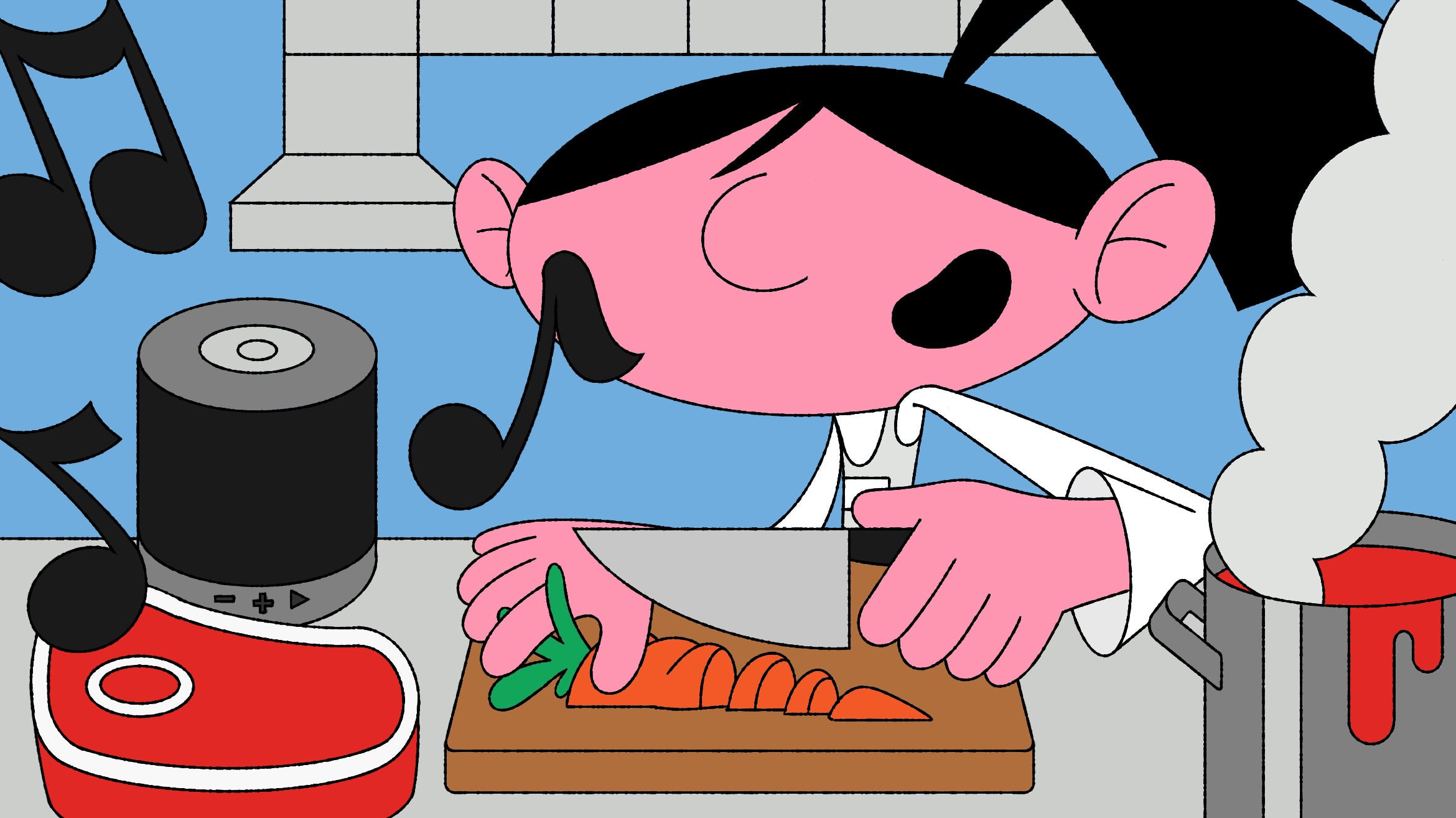
From bakeries to fine dining restaurants, good playlist is an essential tool in every kitchen.
It was 8 a.m., and I could barely hear the music. The sharp thwack of the bench scraper was louder than the song playing from the small cherry-colored Bluetooth speaker on the speed rack next to me, and Jack, a grizzly bear of a prep cook, was the only other person in the basement prep kitchen besides John-John, who was intaking the whole milk. I felt out of place and green, barely three weeks into the job. The wet dough clung to my sweaty palms, and the more flour I used, the more my hands burned with eczema. I was still in my head, desperate to remain invisible.
“Can’t hear a single note they’re playing,” mumbled Jack. I doubted he’d ever listened to Soccer Mommy and was fairly sure he wasn’t keen on starting today.
“You like the Replacements?” he grunted. I said I’d never heard of them, and he took over the speaker. He pumped the volume up to full blast. My mind was blown.
Early on in my first job as a pastry cook in New York, music was the key to getting me out of my head and connecting with the other cooks around me, allowing me the chance to gain confidence and conviction in the kitchen. After that day, I played music you could hear from the walk-in freezer all the way to the linen closet: alt ’90s rock interlaced with the bubblegum throwback pop of Christina Aguilera and Gwen Stefani. To many chefs, music is an integral part of the morning prep routine, hours before dinner service begins and the first glass of wine is poured.
“When I get into the restaurant, everything’s very quiet,” observes Telly Justice, the chef and co-owner of HAGS, a queer fine-dining restaurant in Manhattan. The morning is the only time when the kitchen is devoid of noise, apart from the whirr of the ovens and the sharpening of knives. Soon a cacophony of sound begins. Music, of course, is king.
“I love to start the day with jazz. It’s a really peaceful but energetic way to set the mood in the room,” says Justice, her morning playlists stacked with the likes of Alice Coltrane and Charles Mingus. But as the heat in the kitchen intensifies, so does the tempo, and esoteric jazz harp and upright bass yields to rock bands like Turnstile or Deftones.
“It’s a hot, dangerous, fast-paced environment,” says Justice, a former punk rock drummer. “When you really need to get the blood pumping, there’s no amount of aggressive music that feels inappropriate. The higher the BPM, the more efficient I feel in my body, and my movements are quicker and sharper.”
Kayla Wong, a baker at Radio Bakery in the Prospect Heights neighborhood of Brooklyn, says that the kitchen’s tempo is entirely dictated by the backing track. When the team arrives at 4 a.m., the sous chefs control the speakers, starting the day with either SZA or Sabrina Carpenter, depending on whether the bakers need an easier start to the morning or something stronger to wake them up while they bake off morning buns and shape loaves of sesame stirato.
“If someone puts on too chill of a radio station for too long, it dulls the energy of the kitchen and creates a slower pace. Usually someone yells out that we need a change,” she says.
In multilingual kitchens, music is a strong way to bridge language barriers, something Chef Ayesha Nurdjaja took initiative over early on in her career.
“When I first started cooking, I spoke Italian, but I did not speak Spanish, and I didn’t really know how to communicate,” explains Nurdjaja, the executive chef and partner at the restaurants Shuka and Shukette in Manhattan. Simple prep tasks and kitchen navigation proved difficult without a common language to share, and Nurdjaja fell behind. It wasn’t until she listened closely to the music her Spanish-speaking cooks played, bass-forward reggaeton and upbeat Latin pop, that she found a way to pick back up again.
“I can memorize lyrics easily, right? When they were listening to music, I would Shazam the songs and have them translated. On the way home, I would study the lyrics to the songs.” The choruses became familiar, and the verses began to stick over time. Soon conversational Spanish came easily to Nurdjaja. For the benefit of the cooks whose first language is Spanish, she encourages everyone in her kitchens to speak Spanish conversationally.
“[Music] shows you that your culture is not the only culture that exists,” says Ignacia Valdés, the executive chef of Tokyo Record Bar, an izakaya-style restaurant and listening room in Manhattan. “We all come from different backgrounds, and when you see someone enjoying the music they put on, you empathize.”
Reggaeton was the soundtrack to Valdés’s teenage years in Chile, where late nights on the dance floor were spent sweating to bass-thumping old-school artists like Daddy Yankee and Jowell & Randy. At Tokyo Record Bar, the hi-fi sound system in the dining room is ignored during morning prep service. Instead 2000s reggaeton plays from portable Bluetooth speakers nestled among tape dispensers and rice-filled Cambro containers. The songs are nostalgic for Valdés and her team—her line cook from Puerto Rico and her porter from Guatemala know all the lyrics to “Salgo Pa’ la Calle” and “Eh Oh Eh Oh,” songs that Valdés danced to when she was a teenager.
“I always say I’m embarrassed because, when I used to live in Chile, it was something that we only listened to when we partied,” says Valdés. “I’m not going to say I love reggaeton because it’s so basic…” But after working in kitchens for 12 years abroad, it’s the music of her club-kid days that brings her home and cultivates community among her team.
“Can’t hear a single note they’re playing,” mumbled Jack. I doubted he’d ever listened to Soccer Mommy and was fairly sure he wasn’t keen on starting today.
In the world of Michelin-starred fine dining, the most musicality a chef might hear in the hours before dinner service is the incessant alarm of a kitchen timer or the rhythmic slash of a sharp knife against a cutting board.
“Music was like a curse word,” recalls Nurdjaja, who worked in several Michelin-starred kitchens where chefs were seldom encouraged to even speak to one another. She remembers hearing her coworkers playing music quietly through their phone speakers on bathroom breaks, a chance to break the tension of the high-stakes silence.
“I get that the perspective is, ‘We’re here to focus, to have all of our senses engaged. We want to hear it, we want to smell it,’” says Justice, who previously worked in fine-dining restaurants like Wildair and Contra. “But I have a very loud and busy mind, and when it’s silent, I can’t get out of the prison of my brain.”
Justice speaks to a feeling that goes hand in hand with the pressed tablecloths and sparkling precision of fine dining: unfettered anxiety, stoked by the intensity of the kitchen. For her, music diffuses tension and erases ambient noise that might otherwise distract her from the task at hand, bringing her closer to a place of levity and imagination. It’s a sentiment shared by the Canadian chef Keith Siu, who listens to indie R&B artists like Dijon and Col3trane while he cooks.
“I’ve been thinking about how music encapsulates a feeling like courage,” says Siu, the chef at Belle Isle in Toronto. Siu, whose menu reflects his Cantonese Canadian upbringing, believes that courage is a vital ingredient in sharing individuality as a chef, exposing a part of yourself through the food you cook. “The music that lets you feel all of your feelings can help you to ideate and iterate on dishes,” he says.
After all, both music and food connect us in ways that leave words unnecessary, evoking memory and empathy. They are both truly universal languages. Paired together, they might be instrumental to unlocking a more ethical work environment for cooks in a culinary landscape defined by restaurants that often market themselves as having a single head chef instead of an entire kitchen team.
“Ultimately, kitchens are about the people that work in them, and that’s what makes a space so special,” says Justice. “Especially in a kitchen that allows the staff to enjoy the music they want to hear and create a moment in time and space for themselves, music is one of the greatest forms of democratization.”