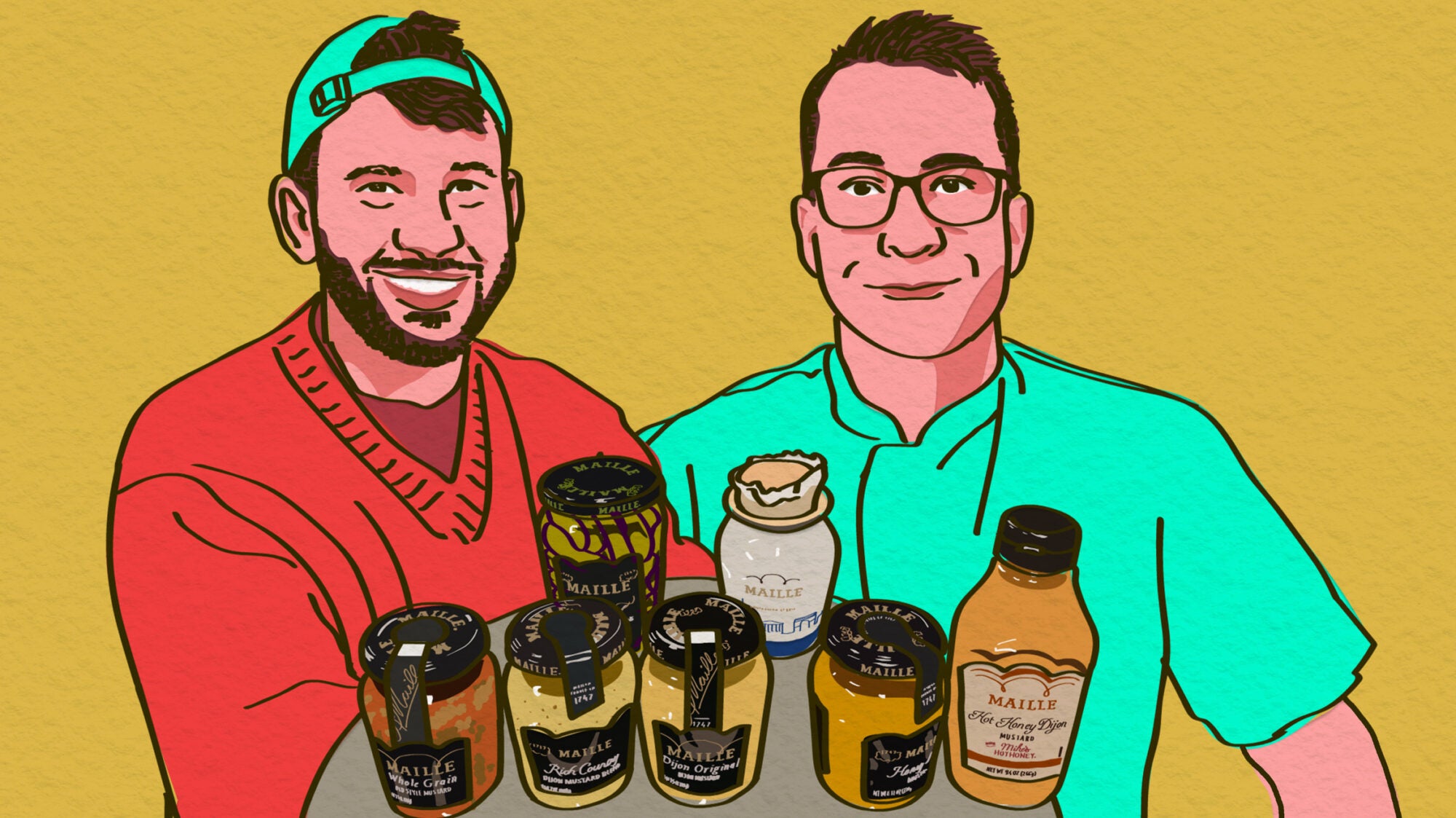
How often do you actually think about the mustard in your fridge? Chef Jeremy Solomon of Brooklyn’s Augie’s Counter and the newly opened Pits thinks about it constantly — and argues you should have at least three to four styles on hand at any given moment. In episode 539 of This Is TASTE, Solomon is joined by Brandon Collins, Maille’s mustard sommelier, for a wide-ranging conversation about Dijon: where it comes from, why it became the condiment of kings (literally), and how far it can stretch across a menu — from braises to brownies to pizza.
| Guest 1 | Jeremy Solomon — Chef/owner, Augie’s Counter & Pits, Brooklyn | Guest 2 | Brandon Collins — Mustard sommelier & R&D collaborator, Maille |
| Key Brand | Maille, founded 1747 in Dijon, Burgundy — the oldest continuously operating mustard brand | One Thing to Know | Dijon works as a 1-for-1 substitute for espresso powder in chocolate baked goods |
What Does Dijon Mustard Actually Taste Like?
Before getting into cooking applications, both guests were asked the same deceptively simple question: how do you describe the flavor of Dijon mustard?
“You want like your nasal passageways to just breathe. It should be spicy and savoury, umami. That’s what a mustard profile would be.”
— Jeremy Solomon, chef/owner, Pits & Augie’s Counter
Collins adds the technical layer: the heat in Dijon comes from glucosinolates — the same compounds that give horseradish and Brussels sprouts their bite. What makes Maille’s Dijon specifically different from English-style mustards like Coleman’s or Tewksbury is how the seeds are processed. The result is heat that registers on the palate without traveling up through the sinuses to make you sweat or tear up.
Collins offered a memorable historical footnote: the reason Maille became the preferred mustard of European royalty wasn’t just about flavor — it was about decorum. “They were wearing makeup, and they didn’t want the commoners to see their makeup run. The way that Maille reacts to your olfactory senses, it didn’t make you sweat and it didn’t make you cry.” Royal warrants followed from the King and Queen of England, the Czars of Russia, Catherine the Great, and the Dukes of Burgundy.
Over 3,000 Years of Mustard — and Maille Since 1747
Mustard has documented culinary use stretching back over 3,000 years. The Dijon style specifically emerged from Burgundy, France, where the same rocky, clay-rich soil that produces some of the world’s greatest Pinot Noir also proved ideal for mustard cultivation. Early versions were made simply from mustard seeds, verjuice (unfermented grape juice), salt, and water — used primarily as a seasoning and, due to mustard’s antibacterial and antimicrobial properties, as a food preservative.
Antoine Claude Maille founded the brand in 1747. The brand’s modern mass following traces to the mid-20th century, when the tagline Il n’y a que Maille qui m’aille — loosely translated by Collins as “My mustard is my mustard” — embedded itself in French culture. When Dijon came to America, it carried an air of exoticism. “It was clearly French. You could say, ‘I’m cooking with Dijon tonight,’ and that meant something.” Migration drove its spread — people arriving from France, Germany, and England brought their preferred mustards with them.
A Tasting Through the Maille Library
Collins arranged the tasting in a deliberate progression — textured to smooth to sweet to spicy. Here’s what the episode covers:
| Old Style Whole Grain | Lightly cracked, soaked seeds — almost caviar-like in texture. A small amount of sugar counteracts bitterness. Great on sandwiches, cheese boards, or whipped into a mustard butter for lamb or mutton chops. |
| Rich Country | A hybrid of Dijon originale and old style with added herbs and spices. Neither purely smooth nor purely seedy — it has its own identity. Ideal for potato salad, mashed potatoes, and as a pizza sauce base. |
| Dijon Originale | The classic — smooth, mellow, never overwhelming. Horseradish notes with a hint of vinegar and salty creaminess. The utility player: great for dressings, marinades, cream sauces, and as an emulsifier in vinaigrettes. |
| Boutique Crock (Chablis) | Fresh-from-the-tap at the Dijon boutique only. Made with Chablis wine instead of vinegar — noticeably spicier, more pungent, no preservatives. As Collins says: “Same mustard, just processed slightly differently — and you taste it.” |
| Honey Dijon | Sweeter than the originals but far less cloyingly sweet than typical American honey mustard. Real honey flavor and real Dijon heat. Great for turkey glazes, roasted fingerling potatoes, and chicken. |
| Hot Honey Dijon (w/ Mike’s) | Maille’s first US brand collab, developed during the pandemic. Less honey than the standard honey Dijon, with a chili pepper finish. The first collab for both Maille and Mike’s Hot Honey in the US market. |
From Vinaigrettes to Chocolate Brownies: How to Actually Cook With Dijon
The central thesis of both conversations: Dijon is a seasoning, not just a condiment. It belongs throughout the cooking process, not just squeezed onto a finished plate.
The Chocolate Trick
Collins’s most surprising revelation: Dijon reacts with chocolate the same way powdered espresso does, amplifying chocolate flavor without tasting like mustard. “If you don’t have powdered espresso in your house — and I don’t — you can do a one-for-one with Dijon and it’s going to react the exact same way. The vinegar, the salt, and the mustard seed will actually help enhance the flavor of that chocolate. It’s not going to taste like you’re eating a mustard brownie.”
Mustard on Ice Cream
Collins’s other unexpected move: spooning old style or stone-ground mustard over high-fat vanilla ice cream — analogous to finishing with olive oil. He recommends Van Leeuwen or Breyer’s for their clean vanilla flavor. Solomon floated a proper Dijon ice cream where mustard accents vanilla rather than stars — “quite interesting and delicious.”
The Marinade
Solomon’s top technique: marinating chicken in Dijon with spices and aromatics before cooking. The mustard tenderizes the protein and helps develop an especially cohesive, flavorful crust. Augie’s Counter uses Maille as the mustard in their famous tuna melt.
Mustard Butter
At Pits, Solomon whips whole grain mustard and Maille Dijon together with white and black pepper into a mustard butter, then smears it across lamb or mutton chops. The tanginess plays against the fat of the meat exactly as it should.
Vinaigrette
Collins’s go-to: high-acid vinaigrettes made with sherry or apple cider vinegar, Maille Dijon, and a blend of olive oil and avocado oil (to temper the bitterness that even good EVOO can bring). The Dijon emulsifies the dressing, holding oil and acid together. For Caesar, he uses lemon; for everything else, Dijon vinaigrette.
Stews and Braises
Solomon traces his mustard fluency back to working at Prune under Gabrielle Hamilton — Dijon ran through the veins of that kitchen, from cream-based sauces to béchamels to fish dishes. At Pits, rabbit stew, chicken stew, and braises all get mustard integrated during cooking.
Pizza
Collins is an advocate for the New Jersey tradition of mustard pizza, and argues Maille Rich Country makes an especially good sauce base. “The mustard is there to act as your sauce.” His formula: great dough, great cheese, minimal tomato, and Maille. “We put Cholula on it. We put hot honey on it. Let’s put some Dijon on the pizza.”
“To me, Dijon is a seasoning. It works so well in enhancing the flavors of everything else. It plays so nicely in the sandbox with everything.”
— Brandon Collins, mustard sommelier, Maille
Where to Find Maille
The standard lineup — Dijon Originale, Old Style, Honey Dijon, Rich Country — is available at most major grocery stores nationwide. The Maille x Mike’s Hot Honey Dijon is available on Amazon. Specialty boutique-exclusive flavors (truffle varieties, Chablis, whiskey smoked black pepper, pink grapefruit) can only be purchased at the Maille boutique in Dijon, France — the oldest mustard store in the world. Maille also produces vinegars (including sherry and balsamic) and olive oils globally.
Rapid Fire: Jeremy Solomon’s Mustard Takes
| Favorite way to use mustard in a salad? | A creamy buttermilk dressing with multiple mustards — whole grain, classic Dijon, a little honey. A trifecta of mustard creaminess. |
| Favorite way to use mustard with meat? | Marinate in mustard with spices and aromatics. It tenderizes and builds a beautiful crust. |
| A flavor pairing that might surprise people? | Maple syrup. Use it with a pork chop. Mustard and pork are bedfellows — the maple sweetness takes it further. |
| Favorite way to use mustard on a sandwich? | Both on it and on the side — mostly on the side so you can dip copious amounts onto every corner. The more mustard, the merrier. |
Frequently Asked Questions About Dijon Mustard
What does Dijon mustard taste like?
Dijon delivers a spicy, savory, umami-forward punch with horseradish-like heat, a hint of vinegar, and a smooth, salty creaminess on the palate. Good Dijon — like Maille — clears your palate and wakes you up without making you sweat or tear up.
What is Maille mustard and where is it from?
Maille is a French mustard brand founded in 1747 by Antoine Claude Maille in Dijon, Burgundy. It earned royal warrants from the courts of England, Russia, and France before spreading globally. The original Maille boutique in Dijon is the oldest mustard store in the world and still serves mustard fresh from the tap in ceramic crocks.
What is a mustard sommelier?
A trained expert in the history, production methods, flavor nuances, and culinary applications of mustard. Maille’s mustard sommelier Brandon Collins serves as brand ambassador, recipe developer, and culinary educator. The role dates conceptually to Maille’s 18th-century founder; the modern training program launched around 2008–2009.
What are the different styles of Maille Dijon mustard?
The main lineup includes the classic Dijon Originale, Old Style whole grain, Rich Country (a Dijon/old style hybrid with herbs), Honey Dijon, and the Maille x Mike’s Hot Honey Dijon collab. The Dijon boutique also offers seasonal tap mustards including Chablis wine, white truffle, black truffle, Parmesan black truffle, pink grapefruit, and whiskey smoked black pepper.
What are surprising ways to cook with Dijon mustard?
Dijon can replace powdered espresso in chocolate baked goods (it enhances chocolate flavor the same way). It can be spooned over high-fat vanilla ice cream like a finishing oil. It works in mustard butters for lamb chops, as a chicken or pork marinade, in mashed potatoes in place of some butter, as a pizza sauce base, and in braises. Maple syrup is a great pairing partner for mustard, especially on pork.
How many types of mustard should you keep in the fridge?
Chef Jeremy Solomon recommends at least three to four: a classic smooth Dijon, a whole grain, a hot honey, and optionally a country-style blend. Each has distinct cooking applications.
Why did Maille become the mustard of European royalty?
Partly flavor, partly chemistry, partly court etiquette. Unlike English-style mustards, Maille’s processing method doesn’t trigger the olfactory heat response that causes sweating or tearing. In an era when European royalty wore heavy makeup in public, a condiment that didn’t make you cry in front of your court was genuinely valuable.
What is Jeremy Solomon’s restaurant Pits in Brooklyn?
Pits is Solomon’s second Brooklyn restaurant, on Van Brunt Street in Red Hook. It serves dinner and cocktails exploring his Southern roots alongside French cuisine and Americana. Signature dishes include a cold meatloaf tea sandwich with pork pâté and Dijon mustard, and a fried country captain capon seasoned with cardamom and turmeric.
Full Transcript
Lightly edited for clarity.
Matt Rodbard: This Is Taste. I’m your host, Matt Rodbard. Today’s episode is all about Dijon mustard and brings a couple of mustard lovers into the studio. First up is Jeremy Solomon. He’s the chef/owner of two singular and sensational restaurants in Brooklyn — Augie’s Counter and the newly opened Pits. We talk about what he’s been cooking and all the creative ways he thinks about using Dijon mustard, even in dessert. Next up is a real treat: we get to talk with a mustard sommelier. His name is Brandon Collins and he helps develop recipes for Maille, which is honestly one of my personal favorite brands. Brandon takes us through some of the company’s history before giving us a taste of some rare Dijons. He brought mustards to the studio. It was so great. I hope you enjoy these conversations.
Matt: Jeremy Solomon, welcome to This Is TASTE. How are you?
Jeremy Solomon: I’m good, thanks for having me.
Matt: Jeremy, before we get into some serious mustard talk, I have to ask you about Pits, your second restaurant you just opened in Red Hook. I’m such a fan of Augie’s Counter — it was one of my favorite restaurants that opened recently. Tell me about your new restaurant.
Jeremy: Yeah. So we just opened — we’re in a corner location on Van Brunt Street in Red Hook. Right now we opened up with dinner and a bar. The narrative leans away from Eastern European cuisine, which is what Augie’s Counter is really rooted in and known for. This explores more of my southern roots and experiences while also pairing it with some French cuisine and Americana. It’s a quirky space. It’s fun, it’s eclectic. It’s kind of like, as our slogan says, a joyful mess.
Matt: Talk about some of the dishes — and maybe if mustard has a little cameo.
Jeremy: It absolutely does. On our appetizer list we have a cold meatloaf tea sandwich. Essentially it’s a pork pâté with pork belly, liver, and fatback. We chill it so all the juices congeal. We slice it up, it goes on really fluffy white sandwich bread, and then it gets Dijon mustard, a little bit of mayo, an onion jam, and then it gets crusted in a wreath of parsley — little tea-time sandwiches. It’s gorgeous, and it’s been selling really well.
Matt: So when did you first realize that Dijon-style mustard can be used across so much cooking, both at home and in restaurants?
Jeremy: I feel like I was exposed to mustard at a very early age. My parents used to take me to diners in South Florida and my father would always order a side of Dijon mustard with his turkey club — just for dipping. There’d be mustard in the sandwich, but also extra mustard on the side. It was just really instilled in me that you should always have mustard with literally everything, even French fries. We were not a ketchup household. It was always mustard or Dijon mustard with your fries. That was my humble mustard beginning.
Matt: Can you describe the flavor of Dijon mustard the way you think about flavor profiles as a chef?
Jeremy: I think about the episode of The Nanny where Fran Drescher eats wasabi — she kind of falls off her stool and all of a sudden her nasal passageways are cleared up. That’s what you want from Dijon mustard. You want your nasal passageways to just breathe. It should be spicy and savory, umami. It wakes you up, but it also excites with all the glutamates and those really spiky flavors.
Matt: What are some fun — maybe surprising — ways you’ve cooked with Dijon?
Jeremy: That’s a career’s worth of recipes. But I feel like the most I have used Dijon has always been in stews and braises — a rabbit stew, a chicken stew. And then obviously sandwiches. You spent some serious time working at Prune — legendary Prune. I have to believe Prune used a little mustard.
Jeremy: Gabrielle used quite a bit of Dijon. The Triscuits and the Dijon and the sardines — and she used it in braises as well. Lots of dressings had it. Even the béchamel had it. Any cream-based sauce had a little bit of mustard in it. And mustard was in a couple of fish dishes too. It ran through the veins of the restaurant.
Matt: When you think about cooking with hot honey Dijon, what comes to mind?
Jeremy: I think of two things. One: pigs in a blanket. Hot honey Dijon is kind of American-French. And pigs in a blanket are so classically American. That would be the ultimate dipping pairing. I also think of the fried country captain capon at Pits — I’ve been eating it every day and trying different dipping accoutrements with it.
Matt: Talk about that dish.
Jeremy: It’s a riff on country captain chicken — almost like a curry-style stew known in the South with all these different spices. We buttermilk-brine the capon, then fry it and hit it with the same spices in country captain: cardamom, turmeric, et cetera. Then it’s served with a carrot-ginger salad. I’ve had it with Dijon and it works beautifully.
Matt: What about buying mustard for the home kitchen — and tell me about Maille?
Jeremy: Every home cook should have a variety of Dijon and mustard in their home. There’s mustard for literally every occasion. At Augie’s Counter we’ve used Maille as our mustard for the tuna melt, which is a daytime dish we’re known for. I definitely keep a jar at home. And call me crazy, but I feel like you should have at least three to four styles of Dijon in your refrigerator. You need whole grain, you’ve got your hot honey, you’ve got your classic — there’s just so many different things you can do.
Matt: How do you think about cooking with whole grain mustard?
Jeremy: We whip it into a butter — mustard butter with Maille Dijon, white pepper, black pepper — and then smear it on top of a lamb chop or mutton chop at Pits. It gives you that nice pop. There’s also the sourness and tanginess that really marries well with a fatty protein.
Matt: Can you use Dijon in dessert?
Jeremy: Why not make Dijon ice cream? I’ve only made mustard ice cream once, and it’s not that Dijon has to be the star — it can be there to accent and help along flavors. I think paired with vanilla is actually quite an interesting and delicious combo, and I don’t think people should shy away from it.
Matt: Brandon Collins, welcome. You’re a mustard sommelier.
Brandon Collins: Yeah, it’s a term I didn’t think existed either.
Matt: Did you make it up or was it something that already existed?
Brandon: So Antoine Claude Maille in the 1700s actually said that whenever he opened boutiques, he wanted to have a mustard sommelier in every one of them. It didn’t really come to fruition until around 2008, 2009, when my predecessor actually developed the training program. And then whenever I started with the company, they were like, “Hey, do you want to do this?” And I was like — sure. Sign me up. Obviously. Let’s do it.
Matt: What does the job entail exactly?
Brandon: It’s part brand ambassador — understanding what Maille is and where it came from — and part understanding that mustard is very nuanced. There’s so much more to it than just the condiment. It’s an ingredient. It’s the grandfather of a lot of the vegetables in the Brassica family — think Brussels sprouts and cabbage. Mustard is one of the most original condiments and seasonings we know of — over 3,000 years of documented usage. I’m a historian. I understand the different nuances of all the mustards. And I’m out there preaching the gospel of how great mustard is.
Matt: Do you work in R&D for new mustards?
Brandon: Yes. As we go through the process of developing new flavors, I influence it as much as I possibly can, but I also rely on our R&D counterparts who understand how the different flavor molecules interact with the mustards. Sometimes I’m like, “Hey, I think this would be amazing,” and they just look at me like I’m insane. And then sometimes I’m like, “Hey, this may not taste great,” and they’re like, “No, no, that works perfectly.” We have some amazing flavors in Europe that I would love to bring here to the States, but it’s not to be currently.
Matt: Tell me about Maille’s history — how did it go from a small product in Dijon to being in lots of stores?
Brandon: We started over 250 years ago — 1747 is when Antoine Claude Maille started the brand. Through history, it became the mustard of kings and queens: the King and Queen of England, the Czars of Russia, Catherine the Great, the Dukes of Burgundy. Around the mid-20th century, the tagline “Il n’y a que Maille qui m’aille” came out — very loosely translated: “My mustard is my mustard.” Once that took off, the quality was always there culinarily, and it just slowly built this mass following. Every time you crack open a jar of Maille, you’re going to get the best quality mustard, the best quality seeds, and it’s going to be super consistent.
Matt: What does Dijon mustard taste like from a technical standpoint?
Brandon: Mostly you’re going to get some horseradish notes, because the same glucosinolates that give you heat are the same that you get in horseradish, Brussels sprouts, and cabbage. You get a nice hint of vinegar and a beautiful salty, smooth creaminess on the palate. One of the really cool things about Maille specifically is the way we process the seeds — it doesn’t come up through your olfactory senses and it doesn’t make you cry or sweat like Coleman’s or Tewksbury. A lot of people think Dijon is this super spicy mustard, but with Maille, it’s not.
Matt: What was the mustard landscape like when Dijon-style mustard was making its way to the US?
Brandon: When Dijon was created in the late 1800s, they were utilizing verjuice — mustard seeds, verjuice, salt, and water. It was there to add flavor to meat, and because mustard is antibacterial and antimicrobial, it could help store and cure things and keep food a little bit safer. When it came over to the States, yellow mustard — French’s being the big one — was already the default. Dijon came over as something foreign, with an air of exoticism. Migration drove its spread, the same way Coleman’s and Tewksbury made it over.
Matt: Let’s talk about how to cook with Dijon. Beyond lemon Dijon chicken — what else?
Brandon: The thing that everybody loses their mind over: Dijon reacts with chocolate the same way espresso does. If you’re making double chocolate brownies or chocolate cake and it calls for powdered espresso — if you don’t have powdered espresso, you can do a one-for-one with Dijon and it will react the exact same way. The vinegar, the salt, and the mustard seed will enhance the flavor of that chocolate. And it’s not going to taste like you’re eating a mustard brownie.
The old style — I like to put it on top of really high-fat vanilla ice cream. It adds that bitter, spicy crunch, similar to finishing with olive oil. And mustard is really great in breads. The way I view Dijon is as a seasoning. We’ve put it in this condiment category because that’s what we’ve always known it as, but it works so well in enhancing the flavors of everything else. It plays so nicely in the sandbox with everything.
Matt: What about honey mustard — some people think that’s a dated ’90s flavor.
Brandon: The honey mustard in the US is very cloyingly sweet — it’s almost like eating candy. The Maille is a honey Dijon, so it’s not nearly as cloyingly sweet as a lot of the others on the market. It has a nice spice level you get from the Dijon. For me, it’s great as a glaze for chicken. Or I mix it with a little bit of mayonnaise and glaze my turkey with it for Thanksgiving. I love throwing it on roasted potatoes — fingerlings tossed in oil and rosemary with honey mustard, roasted for 35–40 minutes at 350–360°F.
Matt: Tell me about the hot honey version — were you at the company when they were developing it?
Brandon: We were developing it during the pandemic and I was having packages shipped to my house as we were tasting through it. When we launched, Mike’s was absolutely ecstatic. It’s a different play on honey mustard — not as sweet, a lot less honey, and you get a little bit of chili pepper at the back end. It was the first brand collab we’d done in the States, and I believe one of the first that Mike’s had done as well.
Matt: Let’s talk salad dressing. Vinegar side or lemon side?
Brandon: I have a very strong affinity for acid — my family is German. I tend to make very high-vinegar, acid-forward dressings, to my wife’s chagrin. But the beauty about using Dijon in a dressing is that it helps emulsify it — it helps maintain that temporary emulsion whenever you shake it up and dress your salad. If I’m making a Caesar, I want lemon for that bright citrus pop. But for a spring salad or vinaigrette, it’s Dijon, a high amount of sherry or apple cider vinegar, and a blend of olive oil and avocado oil. The avocado oil offsets some of the bitterness you can get even from a good olive oil.
Matt: So you brought a bunch of Maille to the studio. How else are we buying Maille beyond the grocery store?
Brandon: Some you can get on Amazon — the Mike’s Hot Honey Dijon is available there. And if you’re ever in France and can make it to Dijon, I highly suggest going. It’s the oldest mustard store in the world. We have decrees from Emperor Napoleon on the wall. We have crocks in the basement given to us by the French division of antiquities — whenever they find a shipwreck they bring them to us. And the mustard comes from the tap in five flavors: a classic Dijon with Chablis wine, white truffle, black truffle seasonally, Parmesan black truffle, pink grapefruit, and a whiskey smoked black pepper.
Matt: The Chablis one is extraordinary — like the same mustard but a completely different experience.
Brandon: You’re literally tasting the same mustard just processed slightly differently. More wine, less vinegar — noticeably spicier, more pungent, no preservatives. The jar version is more utility. The tap version is what you’ll get at nicer restaurants — the Balthazars of the world, the McNally joints.
Matt: What about mustard on pizza — is that a real thing?
Brandon: In New Jersey there’s this great tradition of mustard pie. Whenever I first discovered that pie four or five years ago, I had really never heard of it. I started playing around with it, and it works so well. Utilizing Maille in that environment — especially Rich Country — it plays beautifully. Really good dough, really good cheese, a small amount of tomato, and the mustard is there to act as your sauce. Even dipping Domino’s in Dijon — let’s just start the trend.
Matt: How is Dijon being used at the high end — across different restaurant levels?
Brandon: It’s across all different levels — from Michelin down to the chopped cheese place on the corner. We’re seeing a ton of use in sauces — mustard cream sauce is everywhere, but also mustard in stocks with tarragon as a pan sauce for chicken, in mashed potatoes, roasted with vegetables. Pistachio and mustard is a pairing that’s gaining traction. Mozzarella and mustard — it cuts through the fat beautifully. And gourmet hot dogs and hamburgers are increasingly using Dijon. You don’t have to be at a Michelin-star restaurant; they’re probably using Dijon. And the guy making your chopped cheese on the corner is probably using it too.
Matt: Brandon, this has been a lot of fun. Thank you so much.
Brandon: Thank you so much. It was a pleasure. My wife — whenever I first started this role, she said she didn’t like mustard. Now she asks, “Did you put mustard in that?” And I say yeah. She says, “OK, I’m going to like it then.” She’s come full circle. I still eat spoonfuls of mustard on a regular basis, and not only does it taste delicious — it’s antibacterial, it’s antimicrobial. It’s good for you. I lost 100 pounds during the pandemic, and I used mustard a lot to help do that.