Why small food brands are turning to online overstock markets to bring their innovative, boutique goods to the masses.
Kari Morris had been through the small food start-up cycle a few times. She cofounded a brand of mixers and syrups, Morris Kitchen, during the Brooklyn-made era of the late aughts, and after selling it in 2019, she partnered with Louise Fritjofsson, a tech entrepreneur, to launch two more consumer packaged goods brands, Family Foods and Mellis. She knows the struggles of scaling production when you’re a tiny minnow in the ocean of Big Food, she’s familiar with the guessing games of forecasting sales when you’re hoping to grow, and she knows the heartache of perfectly good product not selling fast enough for an approaching best-by date, or of a new SKU not performing well or going out of season.
For Morris, the lightbulb moment for her and Fritjofsson’s next venture came in January 2021, when they had too many vegan ginger cookie baking mixes. They’d launched a limited-edition mix for the holidays, but by January, they were left with about 2,000 cases of still-good seasonally adorned leftovers, which traditional retail outlets no longer wanted to buy.
“We could sell it to TJ Maxx, and they would probably take it,” Morris recalled in a recent phone interview. “But as a vendor coming from the food industry, it’s like, ‘That’s it? There’s gotta be more.’”
TJ Maxx, HomeGoods, Marshalls, and other secondary retail stores have plenty of fans who delight at the discovery of Adidas sneakers and Le Creuset oven mitts for a fraction of their original retail prices. This is where last season’s products often wind up when they’re no longer considered a good fit for traditional retailers but are perfectly good otherwise. Although it’s probably not top of mind for most shoppers, these stores also carry an assortment of shelf-stable food products (think outrageously flavored sea salts and obscure hot sauces) that are there for the treasure hunting as well.
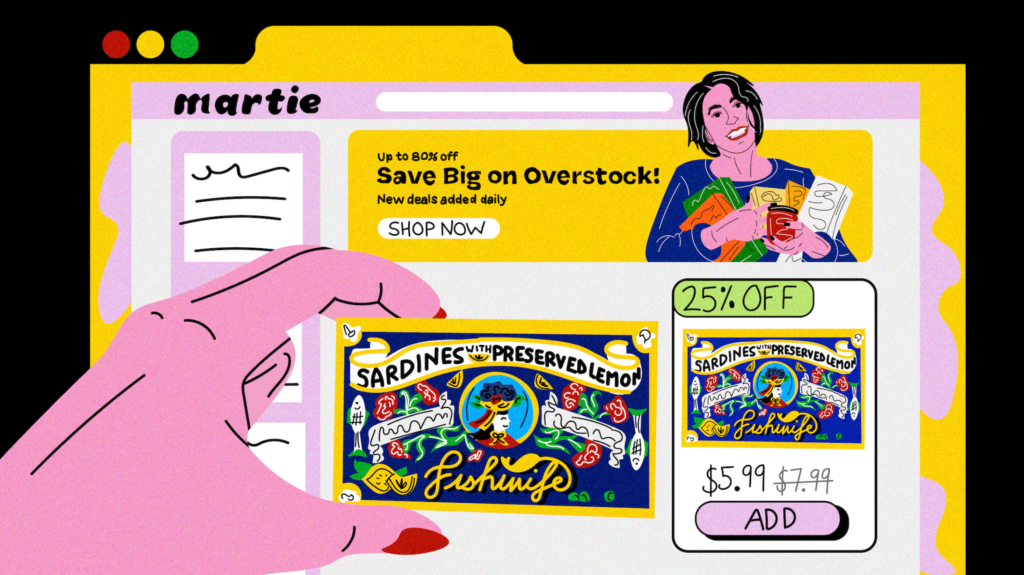
Then there are secondary stores specifically for groceries, dubbed “salvage grocery stores,” where business has been booming lately as inflation drives up food costs. But when Morris and Fritjoffson surveyed the secondary store marketplace in 2021, they didn’t see anyone else selling these types of products online. That November, they launched Martie, initially as an online marketplace for shelf-stable food products sold at a heavy discount due to being overstock, nearing their best-by date, displaying a packaging error, or another issue where quality isn’t compromised. Martie has since expanded its offerings to include secondary-retail cosmetics and home goods in addition to nonrefrigerated packaged food and beverages.
With colorfully illustrated branding and a mission statement aiming to reduce waste by putting “amazing products in the hands of smart, sustainability-minded shoppers,” Martie’s food selection is filled with cult-favorite pantry goods like tinned sardines from Fishwife, calamansi seltzer from Sanzo, plum preserves from Bonne Maman, and instant ramen from Momofuku, as well as more lesser-known brands touting snacks like sweet pea puffs and cosmetics like regenerative beef tallow moisturizer.
“Let’s celebrate that we all have surplus at one point or another; instead of making this disappear, let’s have it go to someone who might otherwise be priced out,” says Morris.
Martie joins a small group of online retailers peeling back the curtain on overstock groceries. Along with the online subscription-model grocers Misfits Market and Imperfect Foods, it’s intent on educating consumers about food waste and the reasons why many of its offerings have ended up there at a discount. These online grocers offer a highly curated assortment of shelf-stable foods and consumer packaged goods, with a selection skewed toward better-for-you products and small start-up food brands. It’s all a stark departure from the food found at brick-and-mortar discount retail stores and salvage groceries, where products may have little in common aside from the fact that they’re significantly discounted for reasons unknown. Together these online retailers are making it fashionable for a new generation of web-savvy customers to shop the secondary or overstock marketplace—especially in the food space.
A waste-not ethos was in fact the impetus for Misfits Market when it was founded in 2018 by Abhi Ramesh. An online grocery delivery service specializing in rescuing “ugly” produce, or food deemed too misshapen for traditional retail markets, the company acquired competitor Imperfect Foods in 2022, and the two brands’ operations are now fully combined, according to senior category manager Kate Tom. Their product offerings have also expanded, however, such that today only roughly 25% of their total current assortment is rescued, overstock, or upcycled food, says Tom. The rest is first-rate produce and shelf-stable foods, all clearly labeled as such, aimed at making the marketplace more of a one-stop shop. “Customers can find innovative emerging brands, exclusive products, and rescued food alongside everyday staples, all in one place,” wrote Tom in an email.
As with Martie, Misfits Market and Imperfect Foods sell a lot of overstock food products from emerging consumer packaged goods (CPG) food brands.
“The thing with start-ups is that everyone gets to a point where they say, ‘Oh my gosh, I have too much inventory,’” says Sherri Sparaga, head of sales for Coro Foods, a Washington State–based maker of salami in flavors that include lemongrass and orange cardamom. Coro’s products can occasionally be found at Martie and Misfits Market. In the last year, the brand recently expanded into stores on the East Coast and into more big chain groceries nationwide, like Kroger and Publix.
These online retailers are making it fashionable for a new generation of web-savvy customers to shop the secondary or overstock marketplace—especially in the food space.
Expanding sales channels requires brands to keep more stock on hand to accommodate bigger orders from bigger customers. But many large grocers require at least six months of shelf life before a product’s best-by date. So if in April Coro Foods has 100 cases of chipotle-and-cocoa-flavored salami left that will expire in June, it might sell them at discount through its distributor or directly to secondary retailers. Or the company could call up Martie or Misfits Market to see if they’d like to sell them through their sites. Unlike the big grocery retailers, these companies would act quickly to move and sell the products before their best-by dates.
“You, as a customer, would have a perfectly good product,” says Sparaga of this latter scenario. “It’s just not going to sit in three warehouses for three months at a time, which you don’t want anyway.”
Of course, food start-ups work hard to reduce overstock product in the first place. Eri Miyagi, cofounder of Cabi, a Brooklyn-based line of Japanese heritage condiments like dashi soy sauce and miso glaze, says that the company has retooled recipes in order to extend the shelf life of its products since launching three years ago. Cabi’s entire line is produced in Japan, and it got burned whenever unexpected shipment delays at the port shaved months off a whole production run’s best-by timeline. Misfits Market and Martie have been a saving grace for those products that fall short of that dreaded six- or eight-month window.
“I like the company essence of not wasting slightly imperfect produce and all, so I’m very happy that we are able to work with them,” says Miyagi of Misfits Market.
Emerging food brands face similar predicaments. They need to move products quickly in order to have enough cash to invest in ingredients for their next batch.
“Even if you sell [to a secondary market] at a loss or at cost, it’s way more meaningful at this stage of growth,” says Morris.
Another thing food start-ups might have in common? Little in the way of marketing budget to buy online ads, making online overstock marketplaces a potentially attractive way to reach new audiences online.
“I personally answer every customer that reaches out through our website, and I’ve seen people say they heard about us through Martie,” says Matthew Ryan, chief marketing officer at the seaweed-products-based Ocean’s Halo.
He says that partnering with Martie has always been a financial net positive for the brand. But he thinks that brick-and-mortar outlet grocery stores are also great for people shopping on a budget. Typically, when Ocean’s Halo has overstock product, he’ll send an email to all potential buyers and sell it to the highest bidder.
“At the end of the day, we want to get our healthy foods to as many people as possible and not have them go to waste,” he says.
Other vendors I spoke with felt that a well-known discount store like TJ Maxx offered their brand a valuable opportunity for discovery, just like the newer online retailers do.
“I can’t express how valuable Martie and Misfits Market and TJ Maxx are to a company like us. They save us from having to get rid of tens of thousands in loss and give us the opportunity to sell it at break even and then have more people discover it,” says Jonas Hanna, cofounder of South 40 Snacks, a brand of fruit and nut bars.
South 40’s carefully sourced cashews, coconut, Marcona almonds, and other raw ingredients often require long lead times to order, since they’re coming from two different continents. Keeping products like nuts as fresh as possible is a challenge that the company is constantly working to overcome.
“A certain percentage of customers will only buy our product at a steep discount, but I’m sure others might buy it at full price when they see it next,” says Hanna.
“Even if you sell [to a secondary market] at a loss or at cost, it’s way more meaningful at this stage of growth.”
Then there are brands that are just happy to be sold on these sites—overstock product or not. The discoverability is the entire point. Confoundingly, my first vendor interview was with the brand manager for Fishwife, the sustainable tinned-fish brand that helped catapult the category into a million girl-dinner memes. Fishwife products are sold through both Martie and Misfits Market / Imperfect Foods. But the company doesn’t actually have any surplus or overstock product to part with. Instead Fishwife occasionally partners with these outlets to offer fully sellable, non-misfit tins for a couple dollars off—say, $5.99 instead of $7.99—just so more people can discover the brand and buy it there.
“It’s part of our experiential sampling and brand awareness,” said Pierre Jamet, head of sales at Fishwife.
Jamet likens the relationship Fishwife has with Martie to the in-store sampling it often does at Whole Foods Markets: drawing in new customers who might not otherwise try the brand with a discount or freebie. In return, Martie gets to sell a coveted brand that customers are eager to fill their baskets with—while maybe trying one or two products from brands they’ve never heard of. In essence, Fishwife is the bait.
Morris says that 90 percent of the products sold at Martie are overstock or approaching expiration, and the remaining 10 percent are for discovery, like Fishwife’s. She doesn’t expect these percentages to change, and she notes that many vendors who have done brand-awareness campaigns with full-price products started out as vendors selling overstock product.
This is similar to what Misfits Market and Imperfect Foods have been doing with CPG brands. Many of the food start-ups they’ve partnered with use the platform to sell off overstock, mislabeled, or nearing-best-by products. Then there are those—including Fishwife—that only use the retailer as a “growth platform,” according to Tom. But in addition to luring new customers, she sees Misfits Market as helping these brands grow more sustainably: “By giving them a high-velocity, data-rich channel to introduce new items, plan production more accurately, and scale sustainably, we help prevent excess inventory from being created in the first place,” she writes.
Of course, online retailers can offer a lot more customer data to vendors than brick-and-mortar stores typically do. And that may ultimately be their advantage over the Marshalls and TJ Maxxes of the world, cute graphics aside. Already, Jamet has said that the Martie shoppers seem more likely to try something new. And he’s seeing an appetite for higher-priced items on the platform. As with any commerce that takes place online, data on customer sales and behavior can be collected, and for some brands, it’s worth the price of admission.
All told, these online players are flipping the script that traditional secondary retail and salvage markets have used. Rather than “celebrating” overstock or congratulating customers for helping to save food waste or supporting small brands, these brick-and-mortar stores tend to be more hush-hush about their products and how they got there. Just check out a line from the website for one distributor of liquidation goods, which promises “absolute secrecy and discretion to safeguard the reputation of the brand.” There’s a fear, I’m told by several of the brands I spoke with, that if a customer sees a premium food product being sold for a fraction of its retail price at one of these vendors, they will value it less than if they’d bought it at full price from a fancy shoppy shop. It’s a bigger perceived risk for new brands than for an established brand like Adidas. But being sold next to a sexy assortment of other mission-driven, emerging brands in a nicely designed online space? That can create a halo effect.
Morris thinks there’s still a lot of education to be done around food waste in the United States—which is estimated to make up between 30 and 40 percent of total production, according to the US Department of Agriculture. Martie has estimated that its shoppers have helped to divert some five million pounds of goods from the waste stream while saving $34 million in discounts from manufacturers’ suggested retail prices in the four years since the company launched. It’s still a small player in the overstock retail space compared with TJ Maxx and others—and even Misfits Market and Imperfect Foods outnumber Martie at four fulfillment centers to its one—but given the amount of ads I’ve been served for Martie on social media, it might be one of the most-online. And for the customer who doesn’t have a shoppy shop or a Whole Foods Market location very close to them, that’s the place to be.