Restaurant voyeurism is all the rage, and open-concept kitchens are changing how restaurants function. But will they change the labor structures that comprise the industry?
When chef George Motz is on the clock at New York’s Hamburger America, a smashburger joint in SoHo, he’s hardly behind the line.
He’s pacing around amid the open-view flat-top griddles and the counter’s vinyl-padded chrome stools, waving hello to one frequent customer with his right hand and another with his left. He might flip one or two 75-25 ground chuck patties between selfies with fans who have seen him in his wildly popular YouTube and Instagram videos.
“Because we’re so open—hey, Tom! Good to see you, buddy,” Motz interrupts himself to greet a regular while I catch up with him on a recent visit. “I designed it to be this social, and the open kitchen is part of that.”
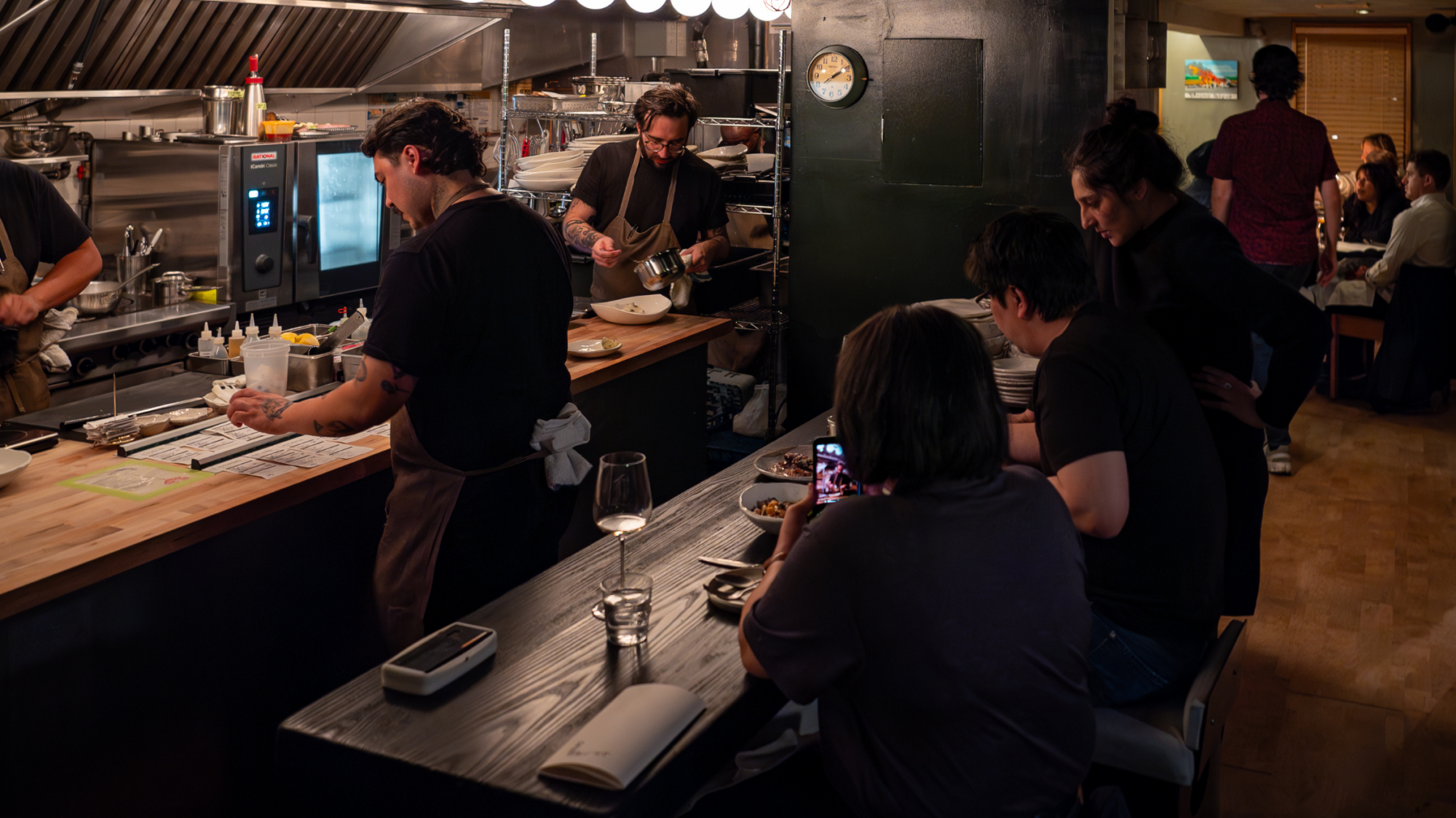
It’s a similar setup for Nick Tamburo, chef and owner at Smithereens, a well-reviewed New England seafood restaurant tucked into the East Village (see photo above). He may not be taking selfies, but he’s giving diners at the low counter facing the kitchen a taste of his latest hyper-fixation of an ingredient, like a slice of pawpaw that is transformed into the evening’s seasonal ice cream. And when Nick’s fellow cook turns to jump on the pass, surrounded by the protein and entremetier stations, the chef de cuisine starts chatting with customers, swapping notes about their favorite days to shop at the farmers’ market.
All the while, from almost every seat in the house at the cozy East Village restaurant, diners can watch garde-mangers finishing off a bluefin tuna crudo with a gentle tweeze of rose petals, hear expeditors calling “Hands” once each dish is ready to walk, and even observe silverware being dunked into tubs of hot, soapy water.
Open-concept kitchens are nothing new, but their growing presence at some of the nation’s buzziest and most critically acclaimed restaurants is hard to see past.
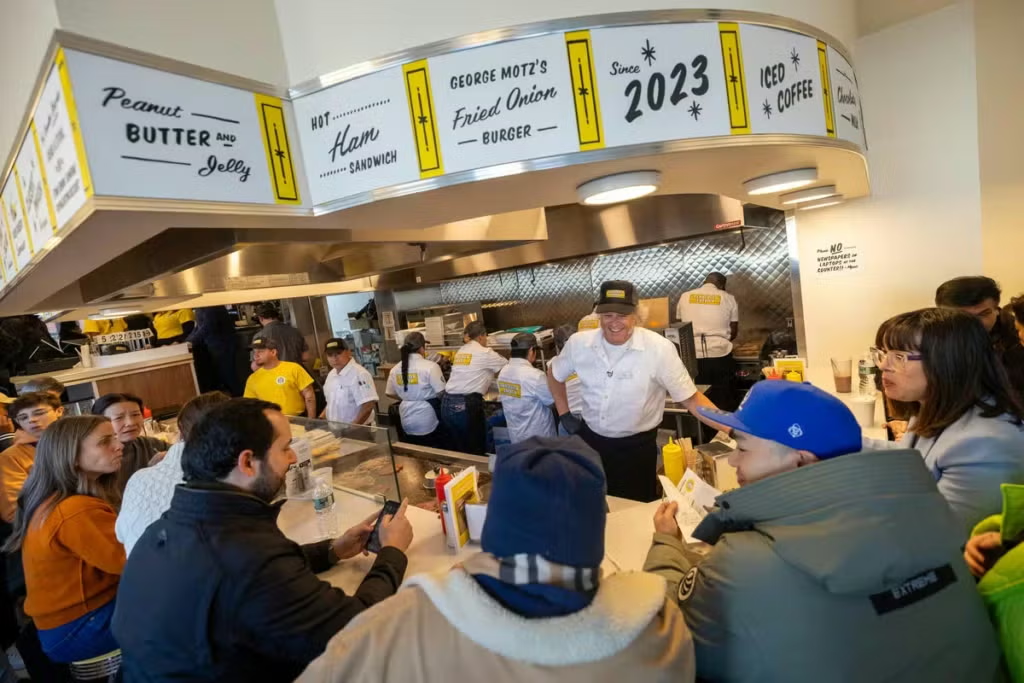
George Motz holding court at New York’s Hamburger America.
While the traditional 1950s American diner setup serves customers on stools directly from the flat-top griddle and remains popular today, contemporary layouts have taken on new meanings. Open kitchens now serve to satisfy the curiosities of both cooks and diners: customers can see the kitchen staff preparing courses, and cooks can see the customers’ instant reactions. These changes in restaurant blueprints aren’t just a matter of aesthetics. They’re reshaping the modern dining experience as well as the labor dynamics that make up the American restaurant.
And critics are catching on. The New York Times’ “America’s Best Restaurants 2025” list features four establishments from New York City: Borgo, Ha’s Snack Bar, Kabawa, and Smithereens. All four are new to the list, have opened within the past two years, and feature a definitively open-concept kitchen format.
“It was my one nonnegotiable, really,” says Suzanne Cupps, chef and owner of Lola’s in Manhattan, who took two years to find a space that could accommodate an open kitchen. “It’s how I’ve gotten to know a lot of the guests. As an owner and the chef, I didn’t want to be stuck in a basement or behind the scenes, where I couldn’t understand what was going on on a daily basis.”
Some chefs and industry experts credit the rise in popularity of open-concept kitchens to David Chang’s opening of Momofuku Noodle Bar in 2004 and Ssäm Bar in 2006. Chang’s innovative approach helped popularize American adaptations of Japanese kappo- and kaiseki-style restaurants, where a squared-off kitchen also serves as a dining counter.
“That led us right into this renewed interest in dining and this new education of the guests, as far as being more interested in ingredients and techniques,” says Tamburo, who met his business partner, Nikita Malhotra, while working at Ko, another open kitchen within the Momofuku empire.
“There’s no picking your nose in front of guests in the kitchen.”
Now diners’ interest in—if not fetishization of—cooks’ livelihoods exists beyond the kitchen. A quick scroll through social media feeds today reveals chef influencers modeling for Ralph Lauren at the Olympics and Cosmopolitan running a feature on “NYC’s hottest line cook.” In 2024, Calvin Klein erected a massive billboard over Houston St. featuring Jeremy Allen White, star of the megawatt kitchen TV drama The Bear, stripped to just boxer briefs.
“Everyone’s read Anthony Bourdain, and they’ve watched The Bear, and they think being a chef is a cool job,” says Ed Szymanski, chef and owner of Dame, a 25-seat English seafood restaurant with an open line. “In generations prior, chefs were considered lowbrow—the help. Now the phrase ‘line cook’ is within the public imagination.”
Because of this deep interest from diners, chefs who operate these dining spaces often encourage their cooks to socialize with and wait on guests, a task typically relegated to front-of-house staff. In the past, the work standards that comprised the hospitality industry in the United States drew a strict divide between front-of-house and back-of-house staff: floor employees performed customer-facing work, whereas cooks did not. Open-kitchen restaurants blur that line.
“All of our cooks here like to contribute to service as well, like bringing food to guests and all that,” Tamburo says of his back-of-house team. “They’re part of that service experience, even clearing tables.”
As much as open kitchens seem to portray a behind-the-scenes scenario, there’s still an element of performance. Hidden in basements at the bottom of creaky stairs are dishwashers power-spraying pan after pan, prep cooks peeling various tubers for hours, and line cooks chopping rapidly to finish their mise en place. When everything is on display in an open kitchen, there’s more pressure on cooks to keep a consistently clean station and on the head chef to refrain from yelling. During a busy push, everyone aims to show off a well-oiled machine.
“There’s no picking your nose in front of guests in the kitchen,” says Szymanski. “You can tell how a cook works by how they behave in a closed kitchen and whether it’s suitable for an open kitchen. They’ve got to be somewhat presentable and friendly. You can’t do the whole chef-shouting-in-the-back thing.”
But a professional kitchen’s energetic hustle isn’t necessarily something to hide. That commotion of banging metal kitchenware and calling out tickets instills a boisterous and lively energy. Szymanski says incorporating an open kitchen is a shortcut to building an upbeat atmosphere.
As diners are increasingly interested in the lives of cooks, and as restaurants continue to respond to that demand, labor expectations have shifted—yet tip structures have not. The well-established pay disparity between front-of-house and back-of-house staff is a direct result of tip-pooling norms. New York state still maintains the once-federal 80/20 regulation, which mandates that 80% of an employee’s shift must be customer facing in order to receive tips. In other words, most back-of-house employees cannot receive tips in America’s biggest city.
“In generations prior, chefs were considered lowbrow—the help. Now the phrase ‘line cook’ is within the public imagination.”
Although cooks can earn a higher hourly wage than tipped employees, front-of-house workers’ tips usually disproportionately outweigh back-of-house income. Line cooks—who tend to arrive earlier, stay later, work full time, and perform under more dangerous and high-stakes environments—often receive a fraction of what floor workers make.
Cooks tending to guests (which is normally considered tippable work) disrupts the industry’s current pay dynamics, typically without a shift in income. There is a loophole, however: owners can legally classify their open kitchen as a “counter,” which overrides the 80/20 rule and allows cooks at a counter to be included in the tip pool.
Some chefs—like Drew Nieporent, the restaurateur behind many of Lower Manhattan’s most influential dining rooms—have successfully implemented that loophole, Nieporent said on TASTE’s podcast This Is TASTE. When he opened Nobu in 1994, his sushi cooks were deemed counter workers and, correspondingly, received tips—which Nieporent says was one of his most audacious moves. Many chefs, however, are still unaware that this loophole exists. Cupps didn’t clarify whether Lola’s classified its kitchen as a counter. She says it’s a tough line to toe.
Instead of relying on legal loopholes, Cupps says, the proliferation of the open model can demonstrate to both customers and lawmakers that the industry should develop more equal pay dynamics. Showing consumers firsthand the toil of working in restaurant kitchens might lead to better wages, she says.
“The reality is that the cooks come in a lot earlier to prep, and so their time is spent in the kitchen,” she says. “[Dissolving the gap] is a tricky area that most kitchens, unfortunately, aren’t able to work into their business model. But it’s more common now for people to be in a kitchen where they see both teams working. Maybe that can contribute to some differences in the law.”
As public interest continues to draw closer to the behind-the-scenes environment of a cook’s day-to-day reality, so does a restaurant’s desired seating. Now the chef’s counter is the new VIP spot—and rightfully so. The splash zone is the best seat in the house.