A global history of the world’s oldest edible luxuries.
Many modern delicacies didn’t have a flashy start. Caviar was deemed peasant food, eaten largely by Russian fishermen in the 12th century. Maine lobsters were once dubbed “cockroaches of the sea,” often fed to prisoners or used as fertilizer. It was only in the face of lobster’s scarcity that we began to laud its buttery flesh and the savory salinity of sturgeon roe. But in our lexicon of edible luxuries, one thing has remained unflappably opulent over time: edible gold and silver.
These consumable noble metals have been revered in ancient Egypt, Rome, Persia, South Asia, China, and Japan. Today, chefs worldwide are embellishing nori-wrapped jamón ibérico, birthday cakes, and burgers with shimmering leaves of gold. The notorious Salt Bae’s Nusr-Et Steakhouse even sells a 24-karat-gold-encrusted tomahawk steak. But flavor has little to do with this enduring fascination, as neither silver nor gold has any discernible taste. So what is it about ingesting material used in jewelry and dental fillings that’s had us in a chokehold for centuries? It starts with a little mysticism and a little medicine.
“The use of edible gold and silver is an ancient practice rooted primarily in the belief that those metals contained medicinal and even immortal properties,” explains food historian KC Hysmith. As early as the 5th millennium BCE, alchemists in Alexandria, Egypt, were developing elixirs made of liquid gold, which they believed would purify and rejuvenate the body. Ayurvedic medicine has long praised silver for its therapeutic, antimicrobial properties. And wealthy families in medieval Europe gave their children silver spoons to suck on to fight infections, which some claim gave birth to the saying “born with a silver spoon in his mouth.”
It was the “perfect” nature of these two elements—their high resistance to corrosion and oxidation—that led many to believe in their remedial properties for centuries. While science does acknowledge gold’s potential anti-inflammatory properties and silver’s antimicrobial properties, ingesting them directly is unmistakably futile. That’s because edible silver (aka 100% nonionic bioactive silver) and gold (23 karats or above) are both biologically inert, meaning they go right through one’s digestive system and into the toilet. This makes them nontoxic, too.
Gold and silver leaf are made by melting the metals into bars, then mechanically rolling or manually hammering them into sheets approximately 0.0001 millimeters thick. Other metals or alloys, such as copper, are often added during the manufacturing process to strengthen the metals for use in crafts and construction, but this renders them unsafe for consumption.
Alarmingly, imitation gold and silver, mixed with varying levels of copper, zinc, aluminum, and other inedible metals, are being sold as edible at online retailers like Amazon. Albert Soo, founder of Barnabas Blattgold, a Hong Kong–based gold and silver leaf producer, tells me that the technical way to tell a fake from the real stuff is through a flame test: “Real gold won’t burn, but imitations will,” he says. For 20 years, Barnabas has been selling its products online to chefs and bakers (it even has a roster of regular content collaborators), and Soo has developed a discerning eye when it comes to fakes. But for those not in the trade, it can be tricky to suss out a counterfeit. “The safest thing to do is to go with a trusted brand, especially as these suppliers get better at creating fakes that are harder to identify,” he explains of this golf leaf that goes for as low as $6 and up to $17 on Amazon.
The biggest clue, according to Soo, often lies in the product reviews and the price. If it seems cheap, it probably is. He worries that the prevalence of these fakes carries risks for both consumers and the legacy of edible metals. “Many chefs and bakers are unaware that these counterfeits exist and that using them can pose real health risks to their customers,” he says. “Raising awareness helps protect both professionals and consumers and maintains the integrity of the craft.”
Edible gold and silver foils have long been common in South Asian cuisines, brought to the region by the Mughal Empire. But it’s edible silver that most often adorns the region’s miscellany of sweets, like fudgy barfi, sweet laddu, and nutty kaju katli. The use of varak, as these noble metals are known here, goes back to 18th-century textile craftsmanship for the royal family in Jaipur. Royal demand attracted skilled artisans to the city and cemented its reputation for high-quality production, explains Mita Kapur, founder of Siyahi, a literary consultancy based in Jaipur. Over time, varak became a key garnish for Indian sweets and food, transitioning it from a purely royal craft to a widespread cultural tradition. While it is still used in some high-end traditional garments, Kapur says that “these days the demand from the food industry, particularly mithai and mishti shops, far outweighs any other use.”
At Huso, the caviar-focused fine-dining spot in Tribeca, two-time Top Chef winner Buddha Lo applies a similar ethos to gilding.
Varak has been the domain of a specific community of Muslim artisans called the pannigars, which literally means “foil makers.” “They’ve been mastering this skill for generations, and you can still find them at work in Pannigaron Ka Mohalla, the neighborhood that houses almost all of the city’s pannigars,” Kapur explains. They hammer away at silver and gold, nestled between the pages of a small book-like piece of equipment called an auzaar, the pages of which are made from sheep or goat skin.
About a decade ago, this age-old method became a dog whistle for India’s Hindu nationalist Bharatiya Janata Party’s (BJP) sustained polemic against the country’s Muslim minority. In 2016, members of the BJP initiated a ban on “handmade” varak. Their claim, according to a report by journalist Prabhat Singh for the National Herald, was that varak was not vegetarian due to the use of “animal intestines” in the hammering process. The pannigars battled the ban in court, asserting that they use only cleaned and processed cattle hide. The court subsequently halted the ban, but the damage was already done. According to Singh’s report, the BJP’s onslaught against the pannigars led to approximately 150,000 varak makers losing their livelihoods to automated factories. Yet Kapur feels hopeful: “There are efforts being made to preserve the craft, with new practices being set up to teach and encourage craftsmen,” she explains, “but it is a complex battle between adjusting to the new and preserving the old.”
In Kanazawa, where almost all of Japan’s gold leaf has been produced since the late 1500s, artisans have become a draw for tourism in the last half decade or so. “The history of Kanazawa gold leaf is a reflection of Japan’s cultural and economic evolution,” says Kenta Moroe, founder of Kanazawa-based gold leaf company Golden Valor. Moroe tells me that it was Lord Maeda Toshiie of the Kaga Domain who, back in 1593, ordered the production of gold and silver leaf for military and ceremonial display, launching the western Japanese city as the premier producer of these noble metals using an ancient technique called entsuke, where metals are hand-beaten between sheets of washi paper made with the fibers of the ganpi shrub. The industry grew, fueled by mechanization and demand during World War I, Moroe explains, but it was after the war that the use of gold and silver expanded to foods. Kanazawa now accounts for more than 99% of Japan’s gold leaf production.
Moroe also explains that in the 1960s, an automated process known as tachikiri was born to enable mass production, enabling the prevalence of more affordable edible metals. Efforts were made, however, to preserve entsuke. In 2020, entsuke gold leaf was recognized as a UNESCO Intangible Cultural Heritage item. The streets of Kanazawa are today peppered with shops serving treats like gold-leaf-gilded soft serve and embellished Japanese sweets (wagashi), drawing millions of tourists to the city every year.
Alarmingly, imitation gold and silver, mixed with varying levels of copper, zinc, aluminum, and other inedible metals, are being sold as edible.
Perhaps the most elaborate use of edible gold took place in 2004 in New York City when chef Joe Calderone landed the quirky Upper East Side dessert parlor Serendipity 3 in the Guinness World Records for serving the world’s most expensive sundae. The Golden Opulence Sundae, which serves one and must be ordered 48 hours in advance, was priced at $1,000. “We had to go big,” he told me, “because it was Serendipity’s 50th anniversary.” Nearly $200 worth of 23-karat gold blankets the Tahitian vanilla ice cream, almonds, and decorative dragée candies that rim the golden goblet and the sugar-molded orchid that takes at least eight hours to make. Despite the cost of gold nearly doubling since 2004, the sundae still costs $1,000 today.
“We put a lot of thought into this sundae. We cryo-freeze it, for example, to give it a longer life—five to six more minutes,” explains Calderone. He admitted that setting a world record was the primary motivation for adding the sundae to the menu, but he didn’t expect it to be so popular with customers. “I never really thought of how this would be in service, but as soon as we hit the news, we had inquiries coming in on a daily basis,” he says. The first year of the sundae’s release, they sold about 40, Calderone told me. The demand hasn’t waned, and the guests run the gamut: a father celebrating his daughter’s law school graduation, a Saudi prince who ordered several and paid cash, a woman who just beat breast cancer.
In 2007, Serendipity 3 broke its own record with an even more extravagant treat—also with tons of gold, of course—called the Frrrozen Hot Chocolate Sundae, with a price tag of $25,000, inadvertently ushering in the Gilded Age of food. That took place right at the inception of the Instagram inferno that would change how we eat and where we eat forever. In the years that followed, it wasn’t taste or quality but hopes for internet virality that had restaurants decking out their otherwise ordinary items in gold.
In 2016, the now-closed KOA, a modern Japanese spot in the Flatiron District, introduced the world’s most expensive ramen, priced at $180 and accompanied by a heaping pile of gold-encrusted wagyu and shaved truffles. That same year, Manila Social Club gave New York City a gold-coated Cristal Champagne doughnut. Just a couple years later in 2018, the Ainsworth, the elevated sports bar in Midtown Manhattan, was selling ten gold-garbed chicken wings for $45. But Calderone isn’t impressed. “They’re taking the mundane and putting gold on it. They’re not taking the exquisite and putting gold on,” he says with a sniff.
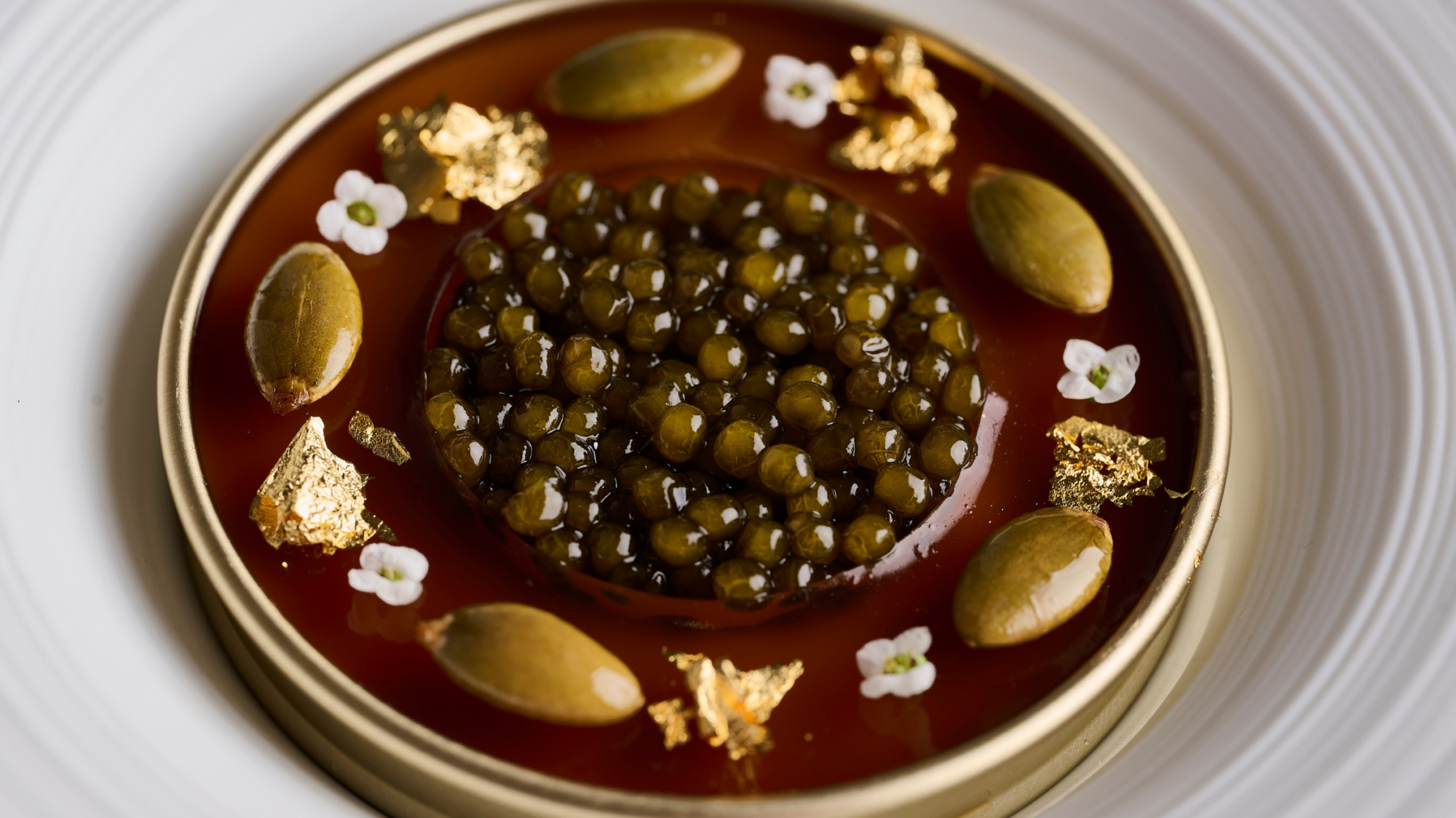
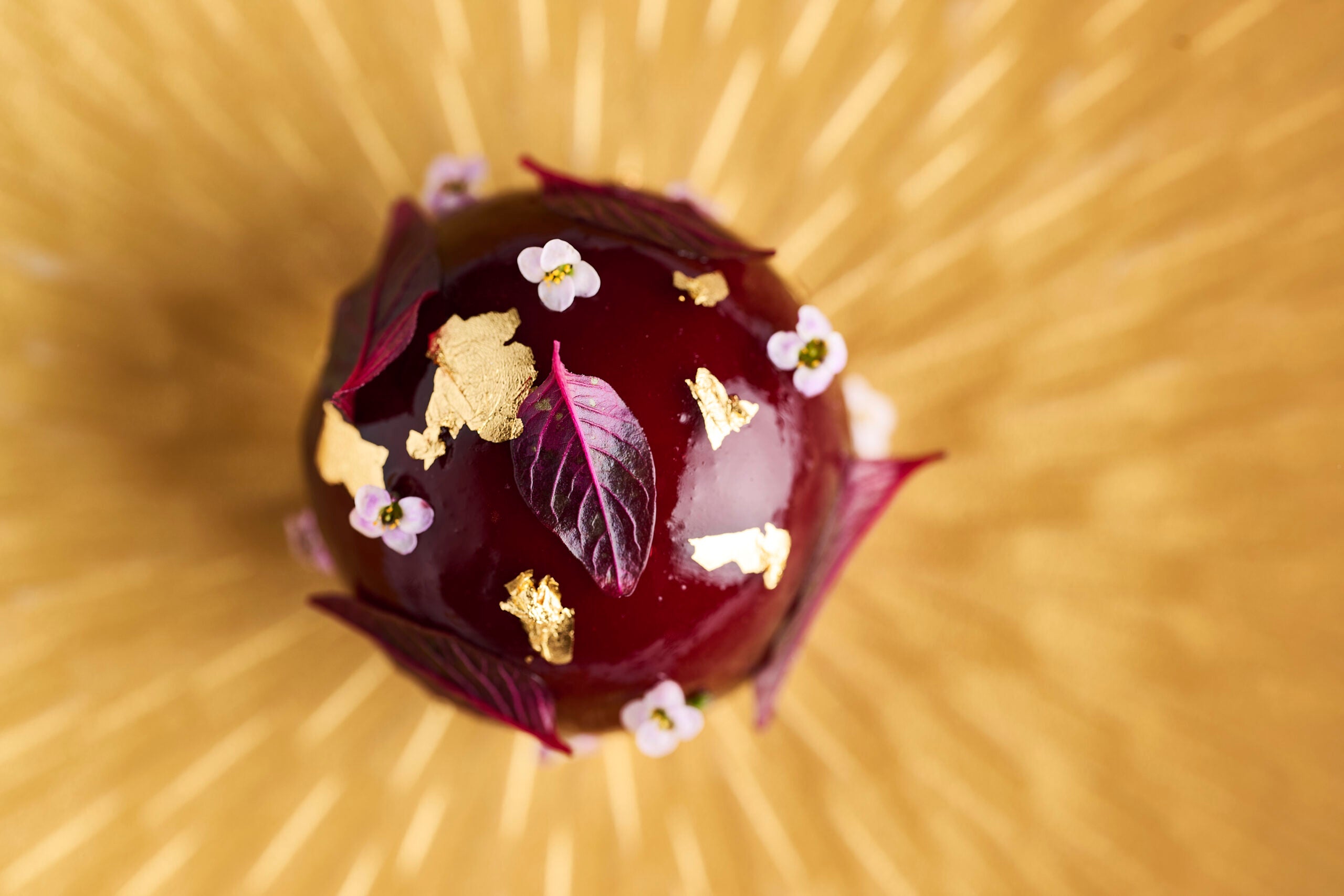
At Huso, the caviar-focused fine-dining spot in Tribeca, two-time Top Chef winner Buddha Lo applies a similar ethos to gilding. “It’s about taking something amazing and amplifying it further,” he explains. On Lo’s current fall tasting menu, the first course features precious spot prawns and a mound of plump, glossy Kaluga hybrid caviar surrounded by a delicate wreath of edible gold leaf. “I use it sparingly and purposefully—usually when a dish already carries a sense of luxury, and a subtle accent of gold adds some visual contrast and a feeling of celebration.”
That, it seems, has been the central draw of edible gold and silver since the beginning: marking the extraordinary, relishing the exquisite. And for those for whom a $25,000 sundae is out of reach, a $20 glistening flake of gold atop an ice cream cone allows for an innocent illusion of excess, even if for a few short moments.